Beyond simple relaxation, pranayama is a precise tool for bio-hacking your nervous system—a fact ancient yogis knew intuitively and modern neuroscience is now proving at the cellular level.
- The yogic concept of Prana (life force) maps directly onto the modern understanding of cellular energy (ATP) production within our mitochondria.
- Specific breathing techniques act as a neurochemical switchboard, allowing you to consciously adjust levels of brain chemicals like noradrenaline and GABA.
Recommendation: To harness this power safely, begin not with complex techniques, but with foundational practices that build your body’s tolerance to carbon dioxide.
For millennia, yogis have insisted that the breath is the master key to regulating our internal state. They called this vital energy Prana, the very fabric of life that flows through us, believing that to control the breath is to control the mind and body. To the modern, scientifically-minded practitioner, this can sound more like mysticism than biology. We often approach breathwork with a simple goal: to calm down. We are told to “just breathe” to reduce stress, a platitude that, while true, barely scratches the surface of what’s happening under the hood.
But what if the ancient masters weren’t speaking in metaphors? What if their claims about mastering energy were a literal, observable reality? The exciting frontier of modern neuroscience is now providing the empirical evidence. Researchers are discovering the precise, tangible mechanisms that connect our breathing patterns to everything from cellular energy production to the release of specific neurotransmitters in the brain. The yogic art of pranayama is shifting from the realm of esoteric wisdom to the forefront of applied neuroscience.
This article bridges that gap. We will move beyond the superficial advice and explore the “why” behind the “what.” We will investigate how the yogic concept of Prana aligns with mitochondrial function, how to begin a practice safely by understanding your CO2 tolerance, and which techniques to use for specific neurological outcomes. Finally, we will unpack the direct, measurable proof that changing your breath for just five minutes can fundamentally shift your entire nervous system. It’s time to see your breath not just as a tool for relaxation, but as the most powerful control panel you own.
This exploration will reveal the concrete science behind the ancient art of breathing. The following sections break down exactly how these practices work, providing both the traditional wisdom and the modern validation you need to deepen your own practice.
Summary: The Scientific Validation of Yogic Breath Control
- Why Yogis Believe Breath Controls Energy and What Science Says About Prana?
- How to Start Pranayama Practice Without Hyperventilating or Feeling Overwhelmed?
- Kapalabhati for Energy or Nadi Shodhana for Calm: Which Practice When?
- Should Pranayama Come Before Yoga Poses, After, or as a Separate Practice?
- The Warning Signs That Your Pranayama Practice Is Causing Harm Rather Than Benefit?
- Why Your Breath Is the Only Autonomic Function You Can Consciously Hijack?
- Why You Cannot Manage Emotions You Cannot Even Identify or Name?
- Why Changing How You Breathe for 5 Minutes Can Shift Your Entire Nervous System State?
Why Yogis Believe Breath Controls Energy and What Science Says About Prana?
The ancient yogic concept of Prana is often translated as “vital life force.” It’s the subtle energy believed to animate all living things. In yogic physiology, the primary way to increase and direct Prana is through the breath. This idea is the bedrock of pranayama. While “life force” can sound abstract, modern science offers a surprisingly direct biological parallel: cellular respiration. Our cells contain mitochondria, tiny power plants that convert oxygen and nutrients into Adenosine Triphosphate (ATP), the body’s fundamental energy currency.
This conversion process is astonishingly efficient. In fact, mitochondrial respiration generates approximately 90% of cellular ATP through oxidative phosphorylation, a process entirely dependent on the oxygen we inhale. From this perspective, Prana isn’t a mystical force but a tangible one; it’s the potential energy carried in each breath, waiting to be converted into the biochemical power that fuels every single bodily function. When a yogi says they are “building Prana,” they are, on a physiological level, optimizing the very process of cellular energy creation.
This connection goes beyond just fuelling muscles. The brain, which consumes about 20% of the body’s oxygen, is exquisitely sensitive to these changes. As a research team from Trinity College Dublin highlighted, the act of breathing has a profound and direct impact on our brain chemistry. Their work shows that focused breathing directly affects the levels of a natural chemical messenger in the brain called noradrenaline. This neurochemical is crucial for focus, attention, and emotional regulation. This provides a clear, measurable link: changing your breath changes your brain’s chemical environment, and therefore, your mental state.
The yogis weren’t just guessing; they were describing a deep biological reality they could sense through refined inner awareness, or interoception. Modern science is simply providing the vocabulary and imaging to map the territory they charted thousands of years ago.
How to Start Pranayama Practice Without Hyperventilating or Feeling Overwhelmed?
The entry into pranayama can be intimidating. Many beginners, eager to experience profound shifts, push too hard, too fast. This often leads to dizziness, anxiety, or hyperventilation—a state of over-breathing that expels too much carbon dioxide (CO2). It’s a common issue, as chronic, low-grade hyperventilation already affects an estimated 6-10% of the general population due to stress and poor breathing habits. Trying an intense pranayama technique on top of this dysfunctional baseline is a recipe for discomfort.
The key to a safe and sustainable practice is not about inhaling more air, but about increasing your body’s tolerance to CO2. CO2 is not just a waste product; it’s a vital signalling molecule that helps regulate blood pH and, crucially, facilitates the release of oxygen from your red blood cells into your tissues (the Bohr effect). When you hyperventilate, you lower your CO2 levels, which paradoxically reduces oxygen delivery to your brain and body, causing the very symptoms you’re trying to avoid.
Therefore, the first step is to gently and gradually acclimate your system. Instead of aiming for forceful breaths or long retentions, start with simple, slow, and rhythmic breathing. The goal is to make the breath smooth, quiet, and even, without any strain or gasping. This gentle approach retrains the brain’s respiratory centre to become comfortable with slightly higher levels of CO2, which is the true foundation of advanced practice.
Case Study: Building CO2 Tolerance Through Gradual Practice
A 2019 study published in PLoS One provides clear evidence for this gradual approach. Researchers had 16 participants perform just 10 minutes of paced breathing daily for seven days. On the first day, 37.5% of participants experienced a significant drop in their end-tidal CO2, a clear sign of hyperventilation. However, by day seven, the training had so effectively built their physiological resilience that none of the participants (bar one who had a low baseline to start) showed this drop. This demonstrates that a short, consistent, and gentle practice effectively builds CO2 tolerance without any complex anti-hyperventilation instructions, making the practice safer and more effective over time.
Your Action Plan: Starting Pranayama Safely
- Establish a Baseline: Sit comfortably and for 2-3 minutes, simply observe your natural breath without changing it. Notice its depth, pace, and whether it’s in your chest or belly. This is your starting point.
- Introduce Coherence: Begin with “Sama Vritti” or box breathing. Inhale for a count of 4, hold for 4, exhale for 4, and hold the breath out for 4. If holding is too difficult, start with just a 4-count inhale and a 4-count exhale.
- Check for Strain: During the practice, constantly check for tension. Are your shoulders creeping up? Is your jaw tight? Is the breath forced or noisy? If so, reduce the count (e.g., to 3) until it feels smooth and effortless. The goal is ease, not effort.
- Monitor for Dizziness: If you feel lightheaded or dizzy at any point, stop immediately. This is a clear sign of over-breathing and reduced CO2. Return to normal, gentle breathing until the sensation passes.
- Prioritise Consistency over Duration: Practice for just 5 minutes every day rather than one long session per week. This consistency is what retrains your nervous system and builds physiological tolerance for deeper practices later on.
Ultimately, starting pranayama is an exercise in listening, not forcing. The initial practice is less about the breath itself and more about retraining your sensitivity to your body’s subtle signals. This patience is what unlocks the door to the practice’s deeper, more transformative benefits.
Kapalabhati for Energy or Nadi Shodhana for Calm: Which Practice When?
Once a practitioner establishes a stable foundation, they can begin to use pranayama as a more precise tool for state regulation. Two of the most well-known and functionally distinct practices are Kapalabhati (“Skull Shining Breath”) and Nadi Shodhana (“Alternate Nostril Breathing”). The common advice is simple: use Kapalabhati for energy and Nadi Shodhana for calm. While this is a useful starting point, the underlying neuroscience reveals a more nuanced picture.
Kapalabhati is a cleansing technique (kriya) involving a series of short, forceful exhalations followed by passive inhalations, often performed at a rapid pace of 60-120 exhalations per minute. This rapid diaphragmatic pumping powerfully stimulates the sympathetic nervous system—the “fight or flight” branch. It increases heart rate, alertness, and blood flow, making it an ideal practice for shaking off morning grogginess or overcoming midday lethargy. However, the effect isn’t purely stimulating. As Dr. Brahmanand Nayak’s clinical analysis suggests, this intense practice can also be associated with a subsequent increase in GABA, an inhibitory neurotransmitter that soothes the nervous system. This explains the feeling of vibrant, clear-headed calm that often follows a round of Kapalabhati; the initial sympathetic charge is balanced by a parasympathetic rebound.
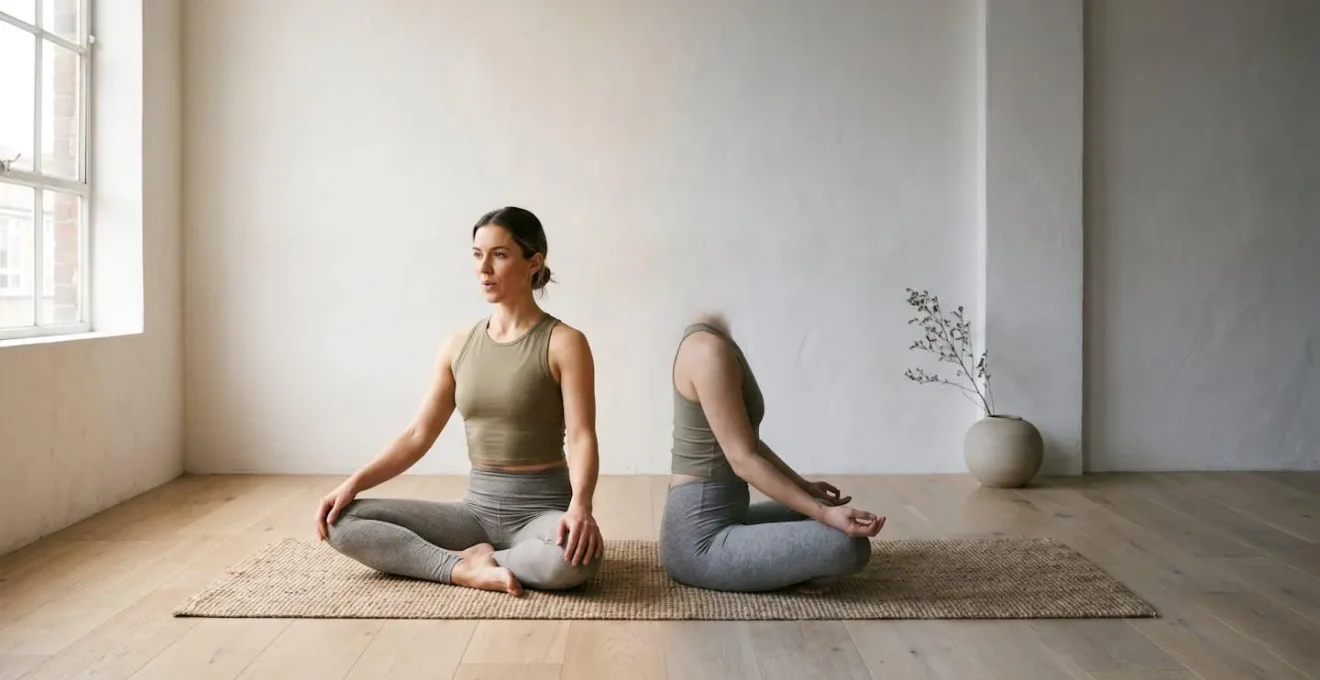
Nadi Shodhana, in contrast, is designed from the outset to balance and soothe. The practice involves gently closing one nostril while inhaling, and then switching to exhale through the other, creating a slow, rhythmic cycle. This simple act of alternating the breath’s pathway is thought to balance the left and right hemispheres of the brain and directly activate the parasympathetic nervous system—the “rest and digest” branch. It slows the heart rate, lowers blood pressure, and quiets the mental chatter. It’s the ideal practice to perform before meditation, after a stressful day, or to prepare for sleep.
The choice is not merely about feeling “energised” or “calm.” It’s about consciously choosing which branch of your autonomic nervous system you wish to engage. Do you need to up-regulate your system for performance and focus (Kapalabhati), or down-regulate it for recovery and introspection (Nadi Shodhana)? This is where pranayama evolves from a simple exercise into a sophisticated form of self-regulation.
Should Pranayama Come Before Yoga Poses, After, or as a Separate Practice?
A common question for practitioners looking to deepen their yoga practice is where, exactly, to place pranayama. Should it be a warm-up for asana (postures), a cool-down, or a completely separate discipline? The answer, supported by both traditional lineage and modern research, is that all three approaches are valid, but they serve different purposes. The best placement depends on your primary goal.
1. Pranayama Before Asana: Performing calming or focusing pranayama (like Nadi Shodhana or Sama Vritti) before physical practice serves to centre the mind and prime the nervous system. It shifts you from the scattered energy of your daily life into a state of present-moment awareness. This allows you to bring a higher quality of attention to your asana practice, transforming it from a mere physical workout into a moving meditation. The breath becomes the anchor for the movement, rather than an afterthought.
2. Pranayama After Asana: This is a more traditional approach in many lineages. The asana practice is seen as a way to prepare the body for the stillness of pranayama and meditation. Physical postures release tension, open the energy channels (nadis), and stabilise the body and mind, making it easier to sit comfortably for an extended period. Furthermore, as studies on yoga-based lifestyle interventions show, asana practice itself has benefits at the cellular level. Research has found that yoga practice can lead to increased transcript levels associated with mitochondrial biogenesis, which means it helps the body build more of those crucial energy-producing power plants. Practicing pranayama after asana can leverage this prepared, energy-rich state for a deeper energetic and neurological impact.
3. Pranayama as a Separate Practice: For those serious about mastering breathwork, dedicating a separate time entirely to pranayama is essential. This allows for the focus and progressive overload needed to train the respiratory muscles and nervous system without the fatigue of a preceding asana session. As research from VIKASA Yoga notes, while integrating pranayama with asana creates a holistic state, “a separate, dedicated pranayama practice allows for deeper, more focused training of specific neural circuits.” This is where you can safely explore more advanced techniques, longer breath retentions, and subtler energetic effects, treating it as a primary discipline rather than an accessory to another practice.
There is no single “right” answer. A beginner might benefit most from pranayama *before* asana to learn focus, while an advanced practitioner might dedicate separate morning sessions to deep pranayama training. The key is to be intentional with your choice, understanding what you are trying to achieve with each session.
The Warning Signs That Your Pranayama Practice Is Causing Harm Rather Than Benefit?
While pranayama is a powerful tool for well-being, it is not without risks when practiced incorrectly. Pushing the body beyond its current capacity can disrupt the nervous system instead of harmonising it. Recognising the warning signs is crucial for ensuring your practice remains a source of benefit, not harm. These signs can be both physical and psychological.
The most immediate physical warning sign is dizziness or lightheadedness. This is a classic symptom of hyperventilation, where excessive CO2 is expelled. As noted in research on paced breathing, this drop in CO2 can cause a cascade of undesirable effects. In the words of the study’s author, “hyperventilation leads to a decrease in arterial pressure of CO2, and when this decrease is large enough it causes several undesirable physiological and psychological changes, such as increase in heart rate, paresthesia and tetany, dizziness, lightheadedness, and increased emotional arousal.” Other physical red flags include headaches during or after practice, pressure in the head or ears, and sharp chest pains.
On a psychological level, a key warning sign is an increase in anxiety, agitation, or emotional volatility. A correctly performed pranayama practice should leave you feeling calm, centred, and clear. If you finish a session feeling more on-edge, irritable, or scattered than when you began, your practice is likely too forceful for your nervous system’s current state. It’s a sign that you have over-stimulated the sympathetic “fight-or-flight” response without allowing for a parasympathetic “rest-and-digest” balance.
A healthy practice has measurable positive effects. A beneficial, externally-paced breathing practice should improve nervous system resilience, which can be measured by Heart Rate Variability (HRV). For instance, a crossover clinical trial found that paced breathing improved this marker, reflected in a logRMSSD of 4.05 ms versus 3.82 ms in the control group. While you may not measure your HRV, the subjective feeling of calm is a good proxy. If you consistently feel worse, it’s a clear signal to stop, step back, and return to simpler, gentler techniques. Ignoring these signs and “pushing through” is counterproductive and can lead to chronic nervous system dysregulation.
The goal is never to conquer the breath, but to befriend it. If the breath is fighting back with symptoms of distress, it’s an invitation to listen more deeply, scale back the intensity, and honour your body’s limits with wisdom and compassion.
Why Your Breath Is the Only Autonomic Function You Can Consciously Hijack?
The human body is governed by the autonomic nervous system (ANS), a sophisticated control system that manages vital functions without our conscious thought. Your heart beats, your food digests, and your pupils dilate, all orchestrated by the brainstem automatically. You cannot consciously tell your pancreas to release insulin or your spleen to filter blood. Yet, one of these core autonomic functions stands alone as a remarkable exception: respiration.
The breath is unique because it operates on a dual-control system. Its primary, life-sustaining rhythm is generated automatically by the brainstem, ensuring you continue to breathe even when you’re asleep or unconscious. However, it is also connected to the somatic nervous system via the motor cortex. As neuroscience research on respiratory control highlights, “Respiration is uniquely controlled by both the brainstem (autonomic, for survival) and the motor cortex (somatic/voluntary). No other core autonomic function has this direct, voluntary cortical pathway.”
This dual wiring creates a “backdoor” into the autonomic nervous system. By consciously choosing to change the pace, depth, or rhythm of your breath, you are using a voluntary, cortical command to directly influence an otherwise involuntary, brainstem-driven process. This is the “hijack” that pranayama exploits. You are taking the wheel of a system that is usually on autopilot. This is not just a party trick; it’s a profound mechanism for self-regulation because the breath is intricately linked with other autonomic functions, especially heart rate and brain state.
The mechanism for this influence is becoming clearer. For example, Trinity College neuroscience research demonstrates that there’s a direct neurophysiological link between breathing and noradrenaline levels in a specific brainstem region called the locus coeruleus. This area acts as a hub for attention and arousal. By controlling your breath, you are directly modulating the activity in this hub, which in turn influences your entire brain’s state of alertness and focus. This is how a few slow breaths can dissipate a feeling of panic, or a few rapid ones can sharpen a sleepy mind.
Every other form of mindfulness or meditation that seeks to influence the autonomic state—whether by focusing on a mantra or observing thoughts—does so indirectly. Breathwork is the only practice that provides a direct, physical lever to pull, making it one of the most efficient bio-hacking tools available to us.
Why You Cannot Manage Emotions You Cannot Even Identify or Name?
We often treat emotions as abstract, psychological events that happen “in our heads.” But every emotion has a distinct physical signature—a subtle shift in heart rate, a tensing in the gut, a change in temperature, a flutter in the chest. The ability to sense these internal bodily signals is called interoception. Modern neuroscience is revealing that this skill is not just a nice-to-have; it’s the fundamental prerequisite for effective emotional regulation.
The concept of “emotional granularity,” popularised by neuroscientist Lisa Feldman Barrett, posits that people who can identify and label their feelings with a high degree of specificity are better at managing them. You cannot effectively manage a vague feeling of “badness.” But if you can identify that “bad” feeling as “disappointment,” “frustration,” or “loneliness,” your brain has a much clearer path to addressing the specific cause and need. And how do we develop this granularity? By first detecting the subtle physical precursors in the body via interoception.
This is where breathwork becomes a powerful training tool. As noted in research on the neuroscience of emotional granularity, “Breathwork trains interoception, and neuroscience shows that the ability to name specific emotions relies on first detecting their subtle physical precursors in the body.” The quiet, focused practice of pranayama forces you to pay close attention to the internal landscape. You feel the subtle expansion and contraction of the ribs, the movement of the diaphragm, the flicker of a nerve. This practice is a workout for the brain’s interoceptive circuits, making you more attuned to your body’s quiet signals throughout the day.
Furthermore, pranayama directly influences the neurochemical environment that governs our emotional state. As research on pranayama neurotransmitter effects indicates, specific breathing practices can lead to observed increases in GABA levels. GABA is the brain’s primary inhibitory neurotransmitter, acting like a brake on anxiety and emotional overwhelm. By increasing GABA, pranayama doesn’t just help you notice emotions; it creates the calm neurochemical space needed to process them without being consumed by them.
In essence, you cannot manage a territory you cannot map. Pranayama is the practice of drawing that internal map. By learning to feel, you learn to identify. By learning to identify, you learn to manage. This is the pathway from reactivity to responsiveness.
Key Takeaways
- Ancient yogic ‘Prana’ directly correlates with modern science’s understanding of cellular energy (ATP) produced via oxygen.
- Your breath is a unique ‘cortical hijack’—the only autonomic function you can consciously control to influence your entire nervous system.
- Effective pranayama is not about breathing more, but about building CO2 tolerance, which allows for safer and deeper practice.
Why Changing How You Breathe for 5 Minutes Can Shift Your Entire Nervous System State?
The idea that a few minutes of breathing can dramatically alter your physiological and psychological state can seem almost magical. Yet, this rapid shift is the result of direct, hardwired biomechanical and neurological mechanisms. It’s not magic; it’s physiology. When you consciously slow down your breath, you trigger an immediate and powerful cascade of events that signals safety to your entire system.
One of the most direct mechanisms involves baroreceptors. As described in cardiovascular research on breathing mechanics, “Slow breathing changes intrathoracic pressure, which is detected by baroreceptors in major arteries. This immediately triggers a reflex arc in the brainstem to lower blood pressure and heart rate.” These baroreceptors are pressure sensors in your arteries that constantly monitor your blood pressure. A slow, deep exhale increases pressure inside the chest, which these sensors interpret as a sign that the system can relax. They send an immediate signal to the brainstem, which in turn commands the heart to slow down and blood vessels to dilate, effectively activating the parasympathetic “rest and digest” response within seconds.
This physiological shift is mirrored by a change in brainwave activity. The brain operates at different frequencies, or rhythms, associated with different states of consciousness. Beta waves are associated with active, focused thought, while alpha waves indicate a more relaxed, non-aroused state, and theta and delta waves are linked to deep meditation and sleep. Pranayama acts as a tool to consciously guide your brain from one dominant frequency to another.
Case Study: Measurable Brainwave Shifts with Rhythmic Breathing
A 2025 study in the journal Nature provided stunning EEG evidence of this effect. Researchers analyzed data from 43 subjects practicing Sudarshan Kriya Yoga, a rhythmic breathing technique. They found that the practice accentuates theta rhythms and dramatically reduces alpha power (with a large effect size of d = 1.70). This shift makes it significantly easier for the brain to transition into a deeply relaxed, meditative state characterized by increased delta-theta rhythms. This isn’t a subjective feeling; it’s a measurable, replicable shift in the brain’s electrical activity, all accomplished within minutes of starting the practice.
When you sit down to practice pranayama, you are engaging with a control panel of unparalleled power. You are leveraging ancient knowledge, now validated by modern science, to consciously and skillfully guide your own nervous system from a state of stress and reactivity to one of calm, clarity, and resilience.