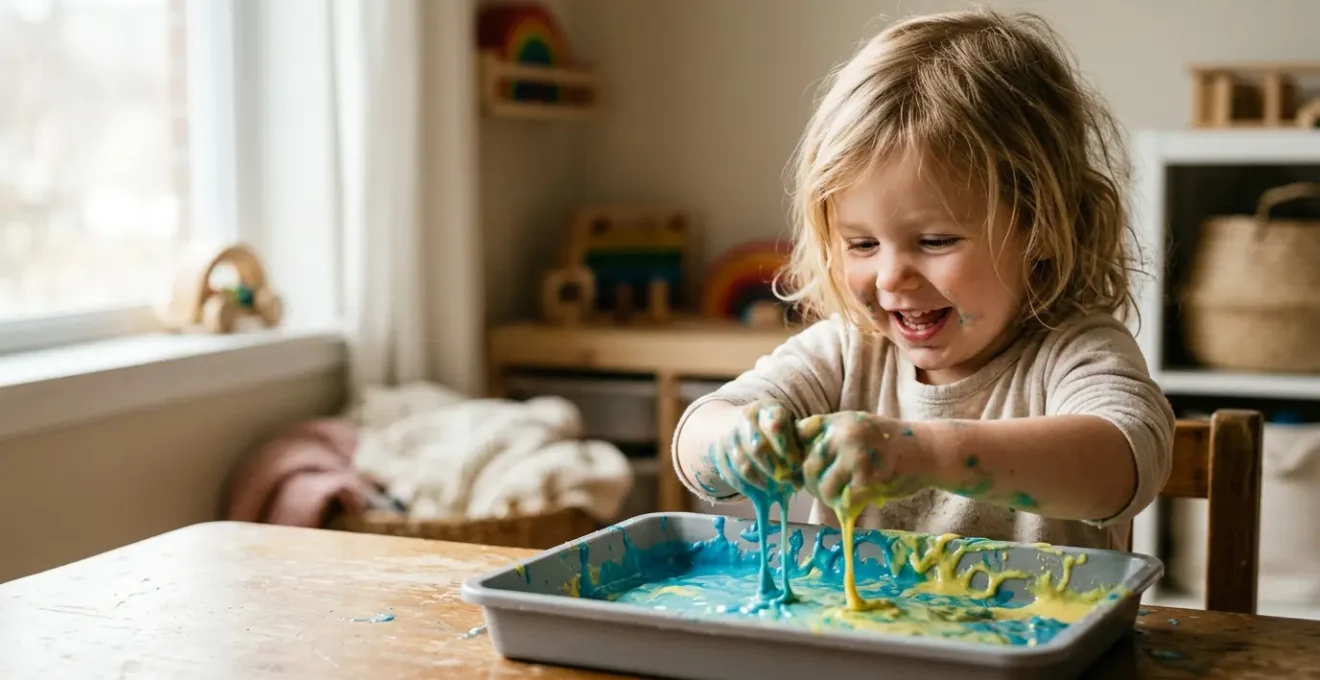
Far from being just a nuisance, messy play is the fundamental work of childhood, actively building your child’s brain for emotional control, problem-solving, and learning.
- The ‘mess’ provides raw sensory data that forges millions of neural connections.
- Physical activities like climbing and jumping are not just burning energy; they are crucial for developing emotional regulation.
Recommendation: Instead of preventing the mess, reframe your role as a guide. Start with one simple, contained activity from your kitchen cupboard and observe the focused learning that unfolds.
Let’s be honest. You see the Instagram posts of toddlers gleefully covered in paint, and your first thought isn’t “what a wonderful learning opportunity.” It’s about the state of the carpet, the 20-minute clean-up operation, and the blue handprints that will inevitably appear on the white walls. For many busy UK parents, the advice to “embrace the mess” feels like another item on an already overwhelming to-do list. You hear the platitudes—it’s good for creativity, it helps with motor skills—but the practical burden often outweighs the vague, promised benefits. The result? You steer clear, opting for tidier, quieter activities, all while harbouring a small seed of guilt.
But what if the entire premise is misunderstood? What if the mess, the noise, and the texture aren’t just inconvenient side effects of play? What if they are the most critical ingredients? The truth is, these multi-sensory experiences are the equivalent of a gourmet meal for a young, developing brain. Each splash, squish, and scrunch is not random chaos; it is a complex dataset being processed, a new neural pathway being forged, and a crucial lesson in emotional regulation being learned. This isn’t just about ‘having fun’; it’s about building the very architecture of a resilient, intelligent, and emotionally aware human being.
This guide moves beyond the clichés to give you the ‘why’ behind the ‘what’. We’ll decode the neurological magic happening amidst the muck, offer brilliant, low-stress ways to introduce sensory play, and show you how to turn what looks like chaos into powerful moments of connection and development. You will learn to see the mess not as a problem, but as evidence of a brain hard at work.
To help you navigate this journey from mess-averse to mess-embracing, this article breaks down the science and strategy into clear, manageable sections. Discover the brain-building power of a simple splash, and find practical ways to make it work for your family and your home.
Summary: Decoding the Developmental Power of Messy Play
- Why Every Splash, Squish, and Scrunch Builds Connections in Your Child’s Brain?
- How to Set Up Brilliant Sensory Play Using Kitchen Cupboard Items?
- How to Adjust Sensory Play for Children Who Avoid or Crave Intense Sensations?
- How to Offer Rich Sensory Play Without Your House or Sanity Being Destroyed?
- How to Turn Messy Play Into Rich Language and Connection Opportunities?
- Why Steaming and Boiling Vegetables Destroys Both Taste and Some Nutrients?
- Why Some Children’s Behaviour Problems Are Actually Sensory Processing Differences?
- Why Climbing, Jumping, and Messy Play Build Emotional Regulation Not Just Motor Skills?
Why Every Splash, Squish, and Scrunch Builds Connections in Your Child’s Brain?
Every time your child plunges their hands into a bowl of wobbly jelly or listens to the crunch of dry pasta, their brain is lighting up like a switchboard. This isn’t just play; it’s a high-velocity neurological workout. In the first few years of life, a child’s brain is astonishingly busy, forming over 1 million neural connections per second. Sensory play is the fuel for this incredible growth. When multiple senses are engaged at once—touch, sight, sound, smell—the brain creates more complex and robust pathways. A child isn’t just ‘playing with mud’; they are feeling its cool temperature, seeing its rich brown colour, smelling its earthy scent, and hearing it squelch. This multi-sensory data helps the brain learn to integrate information, a foundational skill for everything from reading to riding a bike.
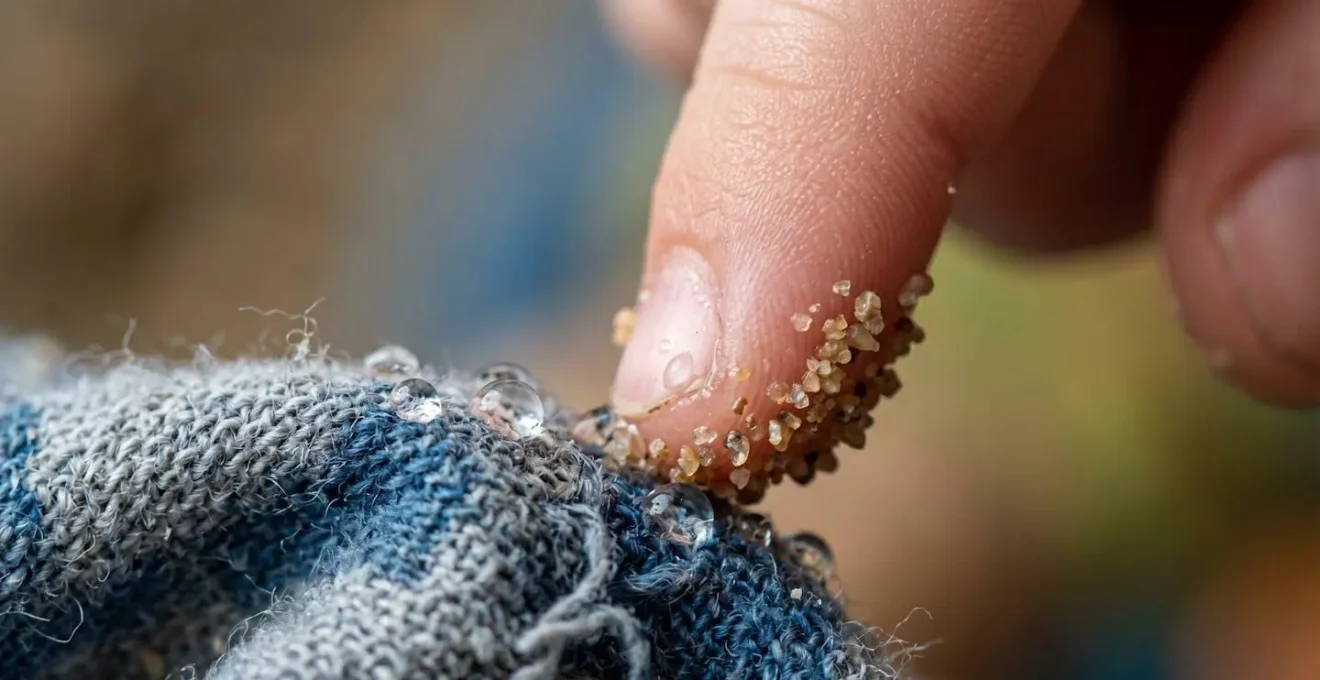
This process of sensory integration is what allows us to make sense of the world. By exploring different textures and materials, a child’s brain builds a ‘library’ of sensory experiences. This library helps them understand complex concepts like cause and effect (“When I squeeze the sponge, water comes out”) and object properties (“This is rough, this is smooth”). This hands-on learning is far more powerful than simply being told. It solidifies abstract concepts into concrete knowledge, creating a strong foundation for future academic learning and problem-solving skills. The mess is simply the residue of this vital construction work.
How to Set Up Brilliant Sensory Play Using Kitchen Cupboard Items?
The idea of ‘sensory play’ can conjure images of expensive, purpose-built toys and complicated setups. The reality is that your kitchen cupboard is already a treasure trove of brilliant sensory materials. You don’t need a special kit; you just need to see the potential in the everyday. As experts from the Cleveland Clinic, Leah Young, CTRS, and Suzanne Messer, MS, OTR/L, point out, simple exploration is key to development.
Allowing your child to freely explore small sensory contents like dried pasta, dry cereal, rice or even slime or play dough can strengthen and build their fine motor skills.
– Leah Young, CTRS, and Suzanne Messer, MS, OTR/L, Cleveland Clinic Health Essentials
The best way to start is by thinking in levels of complexity, gradually introducing new textures and combinations. This respects your child’s pace and minimises your own overwhelm. A structured approach can turn a simple bag of rice into a powerful learning tool, building skills from basic motor control to complex cognitive discrimination. Here is a simple hierarchy to get you started.
Your Action Plan: The Kitchen Cupboard Sensory Play Hierarchy
- Level 1 – Dry & Separate: Start with the basics. Provide a tray with dried pasta, rice, or oats and some scoops or containers. The goal here is pouring, scooping, and transferring, which develops hand-eye coordination and an understanding of volume (proprioception).
- Level 2 – Dry & Mixed: Combine two different dried items, like lentils and chickpeas, with funnels and spoons. This encourages the child to sort and differentiate, building crucial cognitive discrimination skills.
- Level 3 – Wet & Simple: Introduce water. A tray with a small amount of water, some kitchen utensils, and a few ice cubes offers a new experience. This is a safe way to explore temperature, buoyancy, and the properties of liquids.
- Level 4 – Textured & Mouldable: Mix cornstarch and water to create ‘oobleck’, a fascinating non-Newtonian fluid that’s both liquid and solid. This is a brilliant, hands-on science experiment that teaches cause and effect in a memorable way.
- Level 5 – Mixed & Complex: Get brave with cooked spaghetti (add a little oil to prevent sticking) or gelatin with small, safe toys hidden inside. This level prepares children for varied food textures, which can help reduce fussiness and food neophobia later on.
How to Adjust Sensory Play for Children Who Avoid or Crave Intense Sensations?
It’s a common scenario: you lovingly prepare a tray of finger paint, and your child recoils in horror, refusing to even touch it. Or, conversely, you have a child who seems to need constant, intense physical input—crashing, jumping, and squeezing. These aren’t just personality quirks; they are often signs of how a child’s nervous system processes sensory information. It is estimated that 5% to 25% of children have differences in sensory integration and processing. Understanding your child’s unique sensory profile is the key to creating play experiences that feel safe and beneficial, rather than overwhelming.
Children can be broadly categorised as sensory avoiders (those with over-responsivity) or sensory seekers (those with under-responsivity or craving). Avoiders find certain inputs (like sticky textures or loud noises) to be genuinely distressing. Seekers, on the other hand, need more intense input to feel organised and calm. A significant study highlighted the complexity of these profiles, finding that 53% of children with sensory processing differences experienced a mix of types, meaning a child might avoid messy hands but crave deep pressure from a big hug. This means a one-size-fits-all approach to sensory play will fail. The goal is to create a personalised “sensory diet” that meets their specific needs.
For the sensory avoider, the approach must be gradual and respectful. Never force them. Instead, use “bridge” tools. Offer paintbrushes, spoons, or tongs so they can interact with the material without direct skin contact. Start with dry, predictable textures like rice or sand before moving to anything wet or sticky. For the sensory seeker, provide activities with strong feedback: jumping on a mini-trampoline, carrying heavy books (heavy work), or playing with dense, mouldable dough. The key is to observe your child’s cues and “dial” the intensity up or down to find their ‘just-right’ level of engagement.
How to Offer Rich Sensory Play Without Your House or Sanity Being Destroyed?
The number one barrier for most parents is the anticipated clean-up. The fear of a sensory explosion across the living room is valid. However, effective sensory play doesn’t have to equal utter chaos. The solution lies in a simple but powerful concept: containment. By setting clear, physical boundaries for the play, you provide a predictable space for your child and a manageable clean-up for yourself. This strategy not only saves your home but also helps your child understand the concept of a designated play space, a valuable lesson in itself.
Think about location and materials. A tiled kitchen floor or an empty bathtub are your best friends. They are waterproof, easy to rinse, and create a natural boundary. A large, shallow storage box, an old baby bath, or a small, cheap inflatable paddling pool placed on a wipe-clean mat can become your dedicated ‘messy play station’. This defines the play area clearly. When the activity is over, the mess is contained, and the clean-up is as simple as tipping water down the drain or wiping one box clean.
Furthermore, not all high-impact sensory play is messy. You can provide rich tactile and visual experiences with virtually zero clean-up. Here are some brilliant, low-mess ideas:
- Water ‘Painting’: Give your child a pot of water and a paintbrush and let them ‘paint’ on outdoor pavement, a brick wall, or a large piece of cardboard. The marks appear and then magically evaporate.
- Sealed Sensory Bags: Fill a sturdy Ziploc bag with hair gel, a bit of paint, and some glitter or small beads. Seal it tightly (use duct tape for extra security) and let your child squish and explore the contents without any contact.
- Bathtub or Shower Play: Use the built-in containment of your bathroom. Shaving foam on the shower screen or bath crayons on the tiles can be easily rinsed away.
- Steamy Mirror Drawing: After a bath, the steamy mirror becomes a perfect, temporary canvas for finger drawing, engaging both visual and tactile senses.
How to Turn Messy Play Into Rich Language and Connection Opportunities?
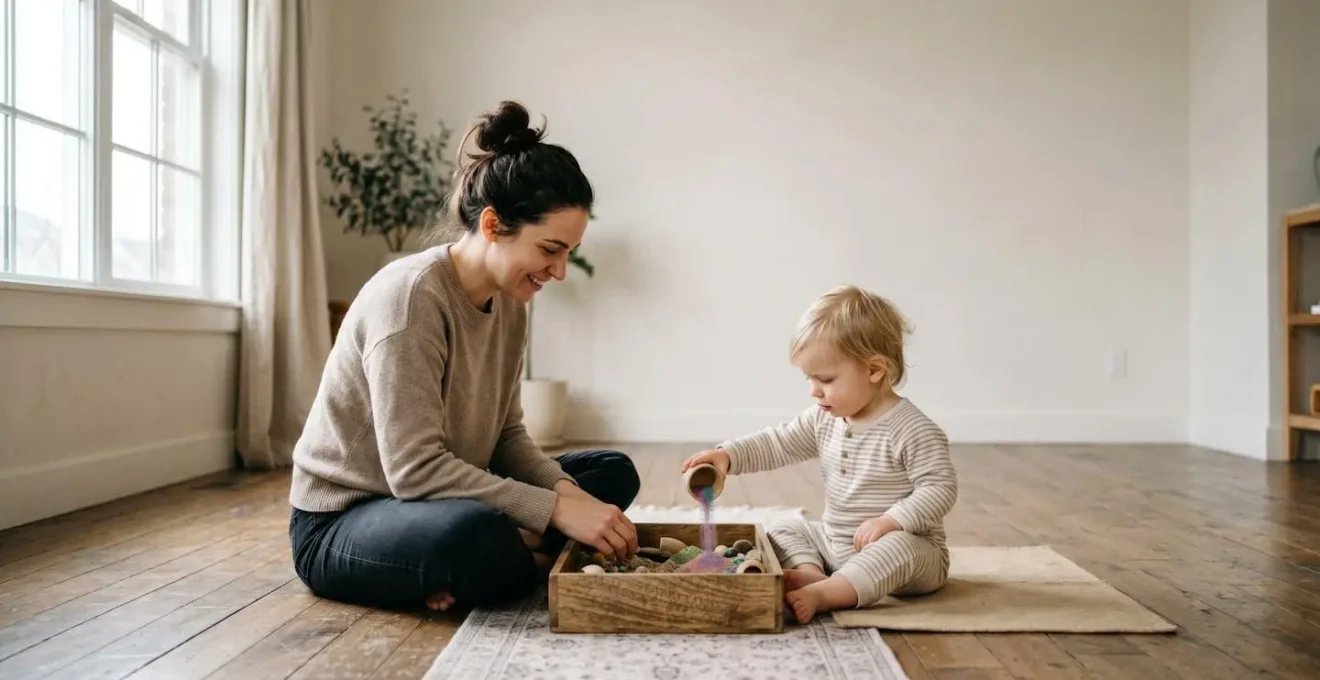
While a child plays, a parent’s instinct might be to step back and let them get on with it. But by engaging alongside them, you can transform a simple sensory activity into a powerhouse for language development and emotional connection. Your role isn’t to direct the play, but to be a ‘sportscaster’ for it—narrating their actions and introducing a rich vocabulary. When a child is squishing playdough, instead of just watching, you can say, “You’re squashing that playdough flat! It looks so soft and pillowy now.” This process of narrating, often called cognitive scaffolding, links their physical experience to words, building their vocabulary and comprehension skills exponentially.
As the Brightwheel Early Childhood Development Team notes, this play is deeply intellectual. Your commentary helps your child form hypotheses and notice outcomes.
When a child experiments with how water moves or what happens when they mix sand and water, they are conducting their own scientific investigations.
– Brightwheel Early Childhood Development Team, Brightwheel Sensory Play Guide
This is your opportunity to upgrade their vocabulary from basic words to rich, descriptive alternatives. A simple vocabulary swap can paint a much more vivid picture in their mind, enhancing their ability to describe their own world. This table shows how you can level-up your language during play.
| Basic Word | Rich Alternatives | Sensory Context |
|---|---|---|
| Wet | Saturated, damp, slick, dewy, moist, drenched | Water play, rain exploration |
| Soft | Velvety, plush, cushiony, pillowy, silky | Fabric exploration, playdough |
| Hard | Solid, rigid, firm, dense, unyielding | Block play, nature items |
| Rough | Coarse, scratchy, abrasive, bumpy, textured | Sandpaper, tree bark |
| Sticky | Adhesive, tacky, gooey, clingy, viscous | Slime, honey, glue |
| Cold | Chilly, icy, frosty, cool, freezing | Ice play, cold water |
Why Steaming and Boiling Vegetables Destroys Both Taste and Some Nutrients?
When preparing food for young children, the default is often to steam or boil vegetables until they are very soft, assuming this is healthiest and safest. While well-intentioned, this process can inadvertently diminish the food’s developmental value. Firstly, water-soluble nutrients like Vitamin C and B vitamins are leached out into the water, reducing the nutritional content. But just as importantly, it creates a monotonous sensory experience. Over-boiling turns varied, interesting vegetables like broccoli, carrots, and sweet potatoes into a uniform, mushy texture. For a brain that is learning to process a wide range of sensory information, this is a missed opportunity.
The goal is not to serve hard, raw vegetables that pose a choking hazard, but to preserve some of their inherent textural variety. A lightly steamed carrot still has a bit of firmness; a roasted piece of butternut squash has a soft interior but a slightly caramelised, textured exterior. As research highlights, this variety is not just for enjoyment; it is cognitive work. According to the team at It’s a Sensory World, an organisation specialising in developmental support:
Research suggests that the varied consistencies and temperatures of foods can significantly contribute to cognitive mapping in a young child’s brain.
– It’s a Sensory World Research Team, Sensory Play: Boosting Child Development Effectively
Presenting food with a range of textures—crunchy, soft, smooth, lumpy—is a form of sensory play in itself. It challenges the brain to adapt and process new information, and can be a powerful tool in preventing or reducing fussy eating. A child who is comfortable with a lumpy bowl of porridge is more likely to be adventurous with other foods later on. Thinking about food preparation through a sensory lens, and not just a nutritional one, opens up another avenue for essential brain development every single day.
Why Some Children’s Behaviour Problems Are Actually Sensory Processing Differences?
A child who is constantly fidgeting, chewing on their shirt collar, or having meltdowns in noisy environments is often labelled as ‘naughty’ or ‘having a behavioural issue’. But what if the behaviour is not the problem, but a communication? In many cases, these actions are the child’s desperate attempt to self-regulate a nervous system that is either overwhelmed or under-stimulated. This is a core tenet of understanding sensory processing: behaviour is communication. A child who can’t yet say “The noise in this supermarket is physically painful to me” will instead cover their ears and scream. A child who needs deep pressure to feel calm will crash into the sofa repeatedly.
The prevalence of this is higher than many realise. One analysis found that among children presenting with developmental and behavioral concerns, 55.9% to 64.4% showed sensory processing difficulties. Ignoring the underlying sensory need and only punishing the behaviour is like putting a plaster on a broken bone. It doesn’t address the root cause and often increases the child’s distress. The first step is to become a ‘sensory detective’, translating the behaviour to understand the message behind it. Once you understand the need, you can offer a more appropriate and effective way to meet it, which in turn reduces the problematic behaviour.
This translation guide helps reframe common ‘misbehaviours’ as sensory signals, suggesting productive responses that honour the child’s needs.
This table can help you translate what your child’s behaviour might be telling you about their sensory needs, based on data from clinical observations of sensory communication.
| The Behavior | The Sensory Message | Suggested Response |
|---|---|---|
| Chewing on shirt collar | My brain needs calming proprioceptive input to focus | Offer chew tools, crunchy snacks |
| Crashes into furniture | I’m seeking deep pressure feedback to feel organized | Provide heavy work activities, pushing/pulling tasks |
| Covers ears in normal noise | My auditory system is overwhelmed; sounds feel too loud | Reduce background noise, offer noise-cancelling headphones |
| Avoids messy activities | Tactile input feels threatening; I need gradual exposure | Use ‘barrier’ tools (gloves, tongs), respect boundaries |
| Constant movement/fidgeting | My vestibular system needs movement to maintain alertness | Allow movement breaks, wobble cushion, standing desk |
| Refuses certain clothing | Tactile sensitivity to tags, seams, or fabric textures | Choose tagless, seamless, soft clothing options |
Key Takeaways
- Messy play is not chaos; it’s the brain’s method for building complex neural pathways using sensory data.
- Challenging behaviours are often a child’s attempt to communicate an unmet sensory need, not a deliberate act of defiance.
- ‘Heavy work’ like climbing, jumping, and pushing provides proprioceptive input that actively calms the nervous system and builds emotional regulation.
Why Climbing, Jumping, and Messy Play Build Emotional Regulation Not Just Motor Skills?
We often think of ‘big body’ play—climbing, jumping, rolling, crashing—as a way for children to burn off excess energy. But this type of play is doing something far more profound: it is building the foundations of emotional regulation. These activities provide powerful proprioceptive input, which is the feedback our muscles and joints send to the brain about our body’s position in space. This input is deeply calming and organising for the nervous system. When a child pushes a heavy box or hangs from a climbing frame, they are giving their brain the strong, clear feedback it needs to feel grounded and in control. This directly activates the parasympathetic nervous system, our body’s ‘rest and digest’ mode, which counteracts feelings of anxiety and overwhelm.
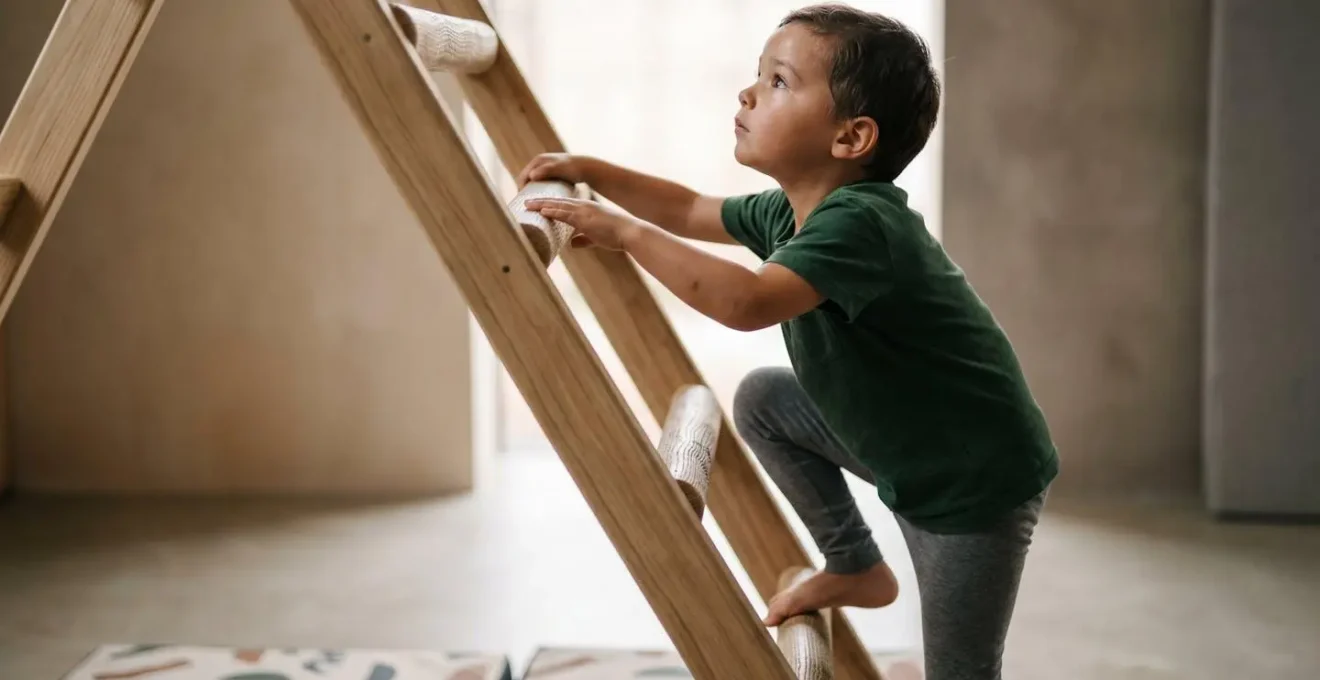
The link between this physical sense and emotional stability is not just theoretical. A recent 2024 study of children with neurodevelopmental conditions found a significant correlation (r = 0.59) between proprioceptive abilities and emotional regulation. Children with a better sense of their body in space demonstrated a stronger ability to understand and manage their emotions. In essence, feeling physically organised helps a child feel emotionally organised. Messy play with resistant materials like dough or clay provides a similar type of ‘heavy work’ for the hands, which is also calming.
So when you see your child climbing the sofa for the tenth time, instead of seeing just boisterous behaviour, recognise the work they are doing. They are seeking the input their brain needs to feel regulated. The challenge isn’t to stop the behaviour, but to channel it. Can you provide a safer alternative? A pile of cushions to crash into? A game of pushing a laundry basket across the room? By providing regular opportunities for this kind of vestibular (movement) and proprioceptive play, you are actively giving your child the tools they need to manage their big feelings long before they have the words to express them.
The next time you see a mess in the making, take a breath. Instead of a problem to be cleaned, try to see the incredible work that’s happening. Your role isn’t to prevent it, but to guide it. Start small, use one kitchen cupboard idea from this guide, and watch as your child’s brain—and your connection with them—lights up with discovery.