
Your recurring clumsiness and injuries are likely not due to weak muscles, but a ‘blurry’ or outdated body map in your brain.
- Inactivity and modern habits cause the brain to receive poor sensory information, leading to a degraded internal sense of your body’s position.
- Targeted proprioceptive exercises actively ‘recalibrate’ this brain map, proving more effective for injury prevention than strength training alone.
Recommendation: Rebuild your body awareness not just by stretching or strengthening, but by incorporating small, daily balance challenges that force your brain to pay attention and update its internal GPS.
Do you ever trip over thin air? Bump into door frames you knew were there? Or perhaps you feel a nagging stiffness that no amount of stretching seems to fix. For many adults in the UK, these moments of clumsiness or persistent aches are dismissed as signs of ageing or simply not being ‘in shape’. We often turn to familiar solutions: more strength training, more stretching, or just accepting it as a new normal. We might even think about related wellness trends, from ergonomic chairs to minimalist footwear, searching for an external fix.
But what if the root of the problem isn’t in your muscles, but in your mind? What if the real issue is that your brain is working with an outdated map of your body? This internal ‘body map’, known scientifically as proprioception, is your brain’s subconscious understanding of where your limbs are in space. When you sit at a desk for hours or stop challenging your balance, this map becomes blurry and unreliable. Your brain loses confidence in the signals it receives from your joints and muscles, leading to hesitation, poor coordination, and an increased risk of injury.
This article moves beyond the generic advice to “do more balance exercises.” We will explore the fascinating science of your brain’s inner GPS and reveal why simply strengthening your muscles is not enough. The key to moving with confidence and preventing those frustrating injuries lies in actively retraining your brain and sharpening its map of your body. It’s a process of re-establishing clear communication between your body and mind.
We’ll delve into why your body sense degrades, provide simple daily exercises to rebuild it, and explain how this neurological approach prevents injuries far more effectively than traditional methods. You’ll learn how to transform basic exercises into powerful proprioceptive challenges and understand the path to recovery after an injury has already occurred. Let’s begin the journey to recalibrate your internal compass.
Contents: How to Update Your Brain’s Outdated Body Map
- Why You Trip Over Nothing and How Ageing and Inactivity Degrade Your Body Sense?
- How to Retrain Your Balance and Body Awareness in 5 Minutes Daily?
- Why Balance Training Prevents More Injuries Than Strength Work Alone?
- How to Add Proprioceptive Challenge to Squats, Lunges, and Other Basic Exercises?
- How Long Does It Take to Rebuild Body Awareness After 6 Weeks in a Cast?
- Why Sitting at Desks and Scrolling Phones Has Rewired How You Breathe?
- Why Children Who Move More Are Often Better at Managing Big Emotions?
- Why You Feel Stiff Despite Stretching and What Actually Improves Mobility Long-Term?
Why You Trip Over Nothing and How Ageing and Inactivity Degrade Your Body Sense?
That frustrating moment when you catch your foot on a perfectly flat pavement isn’t just a clumsy accident; it’s a neurological misfire. It’s a sign that your brain’s internal GPS—its map of your body in space—has become unreliable. This decline in proprioception, or body sense, is often associated with getting older. It’s true that more than one out of four older people (65+) falls each year, a statistic directly linked to this sensory decay. However, age is not the only culprit. A sedentary lifestyle, regardless of age, is a primary driver of this “sensory smudging.” When you spend hours sitting, you starve your brain of the rich, varied movement data it needs to keep its body map sharp and updated.
The mechanism behind this is a gradual breakdown in communication. Research confirms that with age and inactivity, the sensory receptors in our muscles and joints (muscle spindles and Golgi tendon organs) become less sensitive. A systematic review on proprioceptive decline highlights that when these signals from the body are impaired, the brain’s ability to process them and react to the environment is also compromised. Your brain essentially starts receiving “noisy” or “blurry” signals about where your foot is, how your knee is bent, or how your weight is distributed. This uncertainty is what leads to hesitation, over-correction, and an increased risk of falls and injuries.
Think of it like driving with a foggy windscreen. You can still see the road, but your reactions are slower and less precise. Similarly, when your proprioceptive feedback is poor, your brain can’t execute smooth, confident movements. It’s not a failure of your muscles, but a failure of the sensory information system that controls them. The first step to fixing this is acknowledging that the problem lies in this brain-body connection, not just in physical strength.
How to Retrain Your Balance and Body Awareness in 5 Minutes Daily?
Rebuilding your brain’s body map doesn’t require hours in the gym. The key is consistency and focus. By “micro-dosing” with short, daily proprioceptive exercises, you can send clear, high-quality signals to your brain, forcing it to pay attention and redraw its internal map. The goal is not to achieve perfect balance immediately, but to challenge your system just enough to stimulate neuroplastic change. Just five minutes of mindful movement can be more effective than an hour of mindless exercise.
Start by incorporating one or two of these simple practices into your daily routine, perhaps while waiting for the kettle to boil or during a break from your desk. The key is to perform them with intention, focusing on the sensations in your feet, ankles, and core.
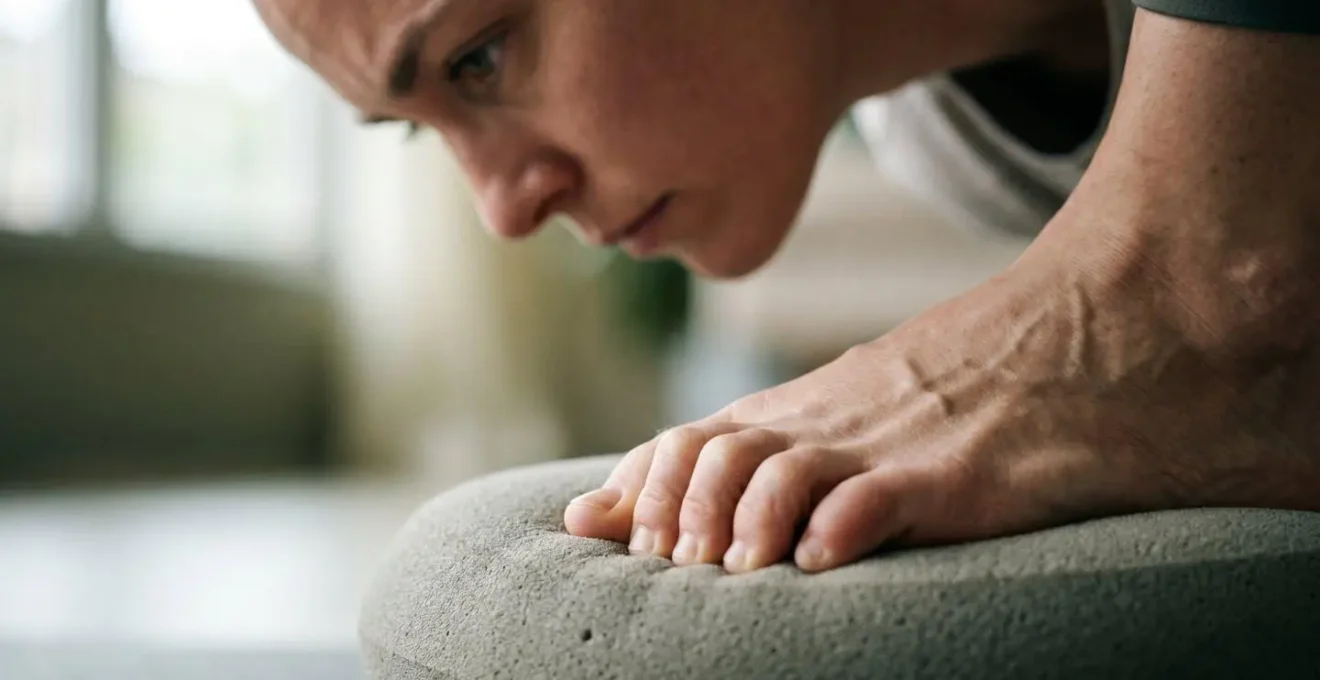
As this image suggests, the power of these exercises lies in the combination of physical challenge and focused attention. You are not just training your muscles; you are actively engaging your brain. Here are a few effective exercises to begin with:
- Single-Leg Stance: Start by balancing on one leg with your eyes open for 30 seconds. Focus on the micro-adjustments in your foot and ankle. To progress, try closing your eyes to remove visual input and force your brain to rely solely on its internal GPS.
- Tactile Exploration: While seated, try to pick up a small, soft object (like a sock) with your toes. This awakens dormant sensory receptors in your feet.
- Slow, Controlled Movements: Practice a very slow walking lunge, focusing on the feeling of weight transfer from your back foot to your front foot. This deliberate pace forces your brain to process sensory information in high definition.
- Body Scanning: Simply stand or sit quietly and mentally scan your body from head to toe, noticing points of contact, tension, or temperature. This strengthens the mind-body connection without any physical movement.
These aren’t just “balance drills”; they are communication exercises. You are teaching your brain to listen to your body again, one clear signal at a time. The consistency of this daily practice is what ultimately sharpens your body map and restores your confidence in movement.
Why Balance Training Prevents More Injuries Than Strength Work Alone?
Many people believe that building stronger muscles is the ultimate shield against injury. While strength is undeniably important, it’s only half of the equation. Imagine having a powerful car engine (strong muscles) but a faulty steering system (poor proprioception). No amount of horsepower can prevent a crash if you can’t steer correctly. This is why balance training, which directly targets the brain’s control system, is often more effective for injury prevention than strength work alone. It addresses the ‘how’ of movement, not just the ‘how much’.
Strength training primarily improves a muscle’s capacity to produce force. Proprioceptive training, on the other hand, improves the nervous system’s ability to control that force at the right time and in the right amount. It trains your reaction time. When you step on an uneven surface, it’s not the sheer strength of your leg that saves you from a sprained ankle; it’s the lightning-fast, subconscious correction orchestrated by your brain based on sensory feedback from your foot and ankle. This is the protective mechanism that balance training refines.
The evidence is particularly compelling in sports medicine. For instance, programs designed to prevent ACL tears, one of the most devastating knee injuries, have shown incredible results when they focus on neuromuscular control. A meta-analysis of injury prevention programs found that incorporating balance exercises led to a 58% reduction in ACL injury risk in soccer players. This is because these exercises train the brain to activate the correct muscles in the correct sequence to protect the joint during dynamic movements like landing or cutting, a task that pure strength building does not address.
Therefore, a truly resilient body is not just a strong body; it’s an intelligent one. By integrating balance work, you are upgrading your body’s software, not just its hardware. This ensures your muscles are not just strong, but are also guided by a precise and responsive control system, ready to protect you from the unexpected.
How to Add Proprioceptive Challenge to Squats, Lunges, and Other Basic Exercises?
Once you’ve started re-awakening your body sense with simple daily exercises, the next step is to integrate this principle into your regular workout routine. You don’t need to add a whole new set of exercises; you can transform the movements you already do, like squats and lunges, into powerful tools for updating your body map. The goal is to introduce small, controlled elements of instability or sensory challenge that force your brain to work harder and refine its motor control.
The key is progressive overload, but not with weight. You’re applying a “sensory overload” to challenge your brain’s processing ability. Instead of just going through the motions, each repetition becomes an opportunity to send high-definition data back to your neurological GPS. This makes your workout not just a physical activity, but a mindful practice in motor learning. By making your environment less predictable, you make your internal control system more robust.
Here are several ways to add a proprioceptive challenge to your basic exercises:
- Manipulate Your Base of Support: Perform squats or lunges on a slightly unstable surface, like a dense cushion, a folded yoga mat, or a BOSU ball. This constantly changing surface forces the small stabiliser muscles in your feet and ankles to fire.
- Introduce Asymmetrical Loading: Hold a kettlebell or dumbbell on only one side during a squat or lunge. Your core will have to work overtime to fight the rotational pull and keep your centre of gravity stable.
- Alter Your Sensory Input: The most powerful tool is often the simplest. Try performing a bodyweight squat with your eyes closed. By removing your dominant visual input, you force your brain to rely entirely on the proprioceptive signals from your body. Even a few seconds can feel incredibly challenging at first.
- Change Your Gaze: During a stationary lunge, slowly turn your head to look far to the left, then far to the right. This challenges your vestibular system (your inner ear’s balance centre) and its connection to your proprioceptive map.
Your 5-Point Proprioceptive Audit: Adding Challenge to Your Workout
- Points of contact: Identify 2-3 core exercises in your routine (e.g., squats, push-ups, planks) where you can safely manipulate stability.
- Collect existing elements: Perform the exercise normally. Now, try it on one leg or with a narrower stance. Note the immediate difference in required focus.
- Check for coherence: Perform an exercise with your eyes closed for 5 seconds. Does your brain “trust” your body’s position, or do you immediately wobble? This reveals the clarity of your body map.
- Assess memorability/emotion: Introduce a slow tempo, taking 5-10 seconds for the lowering phase of a squat. The feeling of intense concentration is your brain actively re-mapping the movement.
- Plan for integration: This week, choose just ONE of these challenges (e.g., asymmetrical loading) and apply it to ONE set of your chosen exercise. Start small to build confidence.
How Long Does It Take to Rebuild Body Awareness After 6 Weeks in a Cast?
Coming out of a cast after an injury, like a broken ankle or wrist, is often met with a mix of relief and frustration. The limb feels weak, stiff, and strangely disconnected—almost like it belongs to someone else. This feeling of alienation is a textbook example of an acutely outdated body map. The six weeks of immobilisation have not just caused muscle atrophy; they’ve created a “black hole” in your brain’s sensory cortex. The constant stream of data from that limb was cut off, and the brain, in its efficiency, down-regulated the corresponding neural pathways.
The good news is that the brain is incredibly plastic. As research from the Ohio Musculoskeletal and Neurological Institute shows, the brain undergoes significant changes after an injury to compensate for the lost proprioception, and modern rehabilitation focuses on retraining these neural pathways alongside physical therapy. Rebuilding this connection is not just possible; it’s a critical part of preventing re-injury. The question is, how long does it take?
While there’s no universal timeline, research provides a solid framework. Effective recovery depends on the consistency and quality of the proprioceptive retraining. You are essentially re-teaching your brain to trust the signals from the injured limb. As experts in the field note, this process yields tangible results. A systematic review published in *Frontiers in Human Neuroscience* concluded:
Proprioceptive training can yield meaningful improvements in somatosensory and sensorimotor function.
– Aman, J.E., et al., Frontiers in Human Neuroscience
Significant improvements in balance and motor control can often be seen within 8 to 12 weeks of consistent, targeted training. This typically involves 2-3 sessions per week, focusing on exercises that challenge the injured area’s sense of position, such as balancing on varied surfaces, tracing letters in the air with an affected foot, or identifying objects by touch with a hand that was immobilised. The initial goal isn’t strength, but rather re-establishing a clear, reliable signal between the limb and the brain.
Why Sitting at Desks and Scrolling Phones Has Rewired How You Breathe?
The modern, screen-focused lifestyle is a primary culprit in the degradation of our body map. When you’re hunched over a desk or slouched on the sofa scrolling through your phone, you’re not just adopting poor posture; you’re fundamentally altering your sensory inputs and even the way you breathe. This static, forward-head posture creates a state of sensory conflict. Your eyes, fixed on a screen two feet away, are telling your brain you are stationary. Meanwhile, the rest of your body—from your compressed diaphragm to your tensed neck—is sending signals of discomfort and misalignment.
In this scenario, your brain defaults to relying on its most powerful sense: vision. However, this comes at a huge cost. To maintain balance, a healthy person’s brain relies on a specific sensory hierarchy. A study in the *Physical Therapy Science Journal* quantifies this, showing that standing posture depends on roughly 70% somatosensory (body sense) information, 20% visual information, and 10% vestibular (inner ear) information. When you sit for hours, you effectively shut down the 70% majority. Your brain stops listening to the subtle feedback from your body because the visual input is so overwhelmingly dominant and unchanging. This is a fast track to a blurry and unreliable body map.
This state also directly impacts your breathing. The slouched posture physically restricts the movement of your diaphragm, the primary muscle of respiration. This forces you into a shallow, “chest breathing” pattern. This pattern not only delivers less oxygen but is also neurologically linked to the body’s stress response (the sympathetic nervous system). A chronically restricted breathing pattern sends a continuous, low-level “threat” signal to your brain, further increasing muscle tension and dulling your ability to perceive subtle internal sensations (interoception). You become disconnected not just from where your body is in space, but from how it feels inside.
Breaking this cycle requires consciously re-engaging with your body’s other senses. It means taking breaks to stand, move, and shift your gaze. It involves taking a few deep, diaphragmatic breaths to reset your nervous system. These small actions are powerful because they re-introduce the sensory variety your brain craves, reminding it that there’s more to your existence than the glowing rectangle in front of you.
Why Children Who Move More Are Often Better at Managing Big Emotions?
The connection between movement and the mind is forged in childhood. When we see children endlessly climbing, spinning, and exploring their physical limits, they are not just “burning off energy.” They are engaged in the most critical neurological development of their lives: building their body map. This process is about more than just learning to move; it’s about building the very neural infrastructure for learning and emotional regulation. A child with a well-developed sense of body awareness is often better equipped to navigate the turbulent world of their own emotions.
Research clarifies that body awareness is a trifecta of interconnected systems: proprioception (knowing where your body is), interoception (feeling internal sensations like a heartbeat or hunger), and the vestibular system (balance and spatial orientation). Activities like climbing, yoga, or martial arts challenge all three simultaneously. According to research on neuroplasticity, when a child engages in these activities, their brain is literally rewiring itself, creating robust neural networks that serve a dual purpose. These pathways don’t just facilitate better coordination; they also support higher-level cognitive functions, including emotional self-regulation.
How does this work? A child who has a clear body map can better identify and interpret the physical sensations that accompany emotions. They learn to recognise the feeling of a racing heart as “excitement” or “anxiety,” the tension in their shoulders as “anger,” or the “butterflies” in their stomach as “nervousness.” This ability to connect an internal feeling to a physical sensation is the first step toward managing it. A child who is “disconnected” from their body experiences these emotions as a confusing, overwhelming flood without a physical anchor. Movement provides that anchor. It teaches them that they can influence how they feel by changing what they do with their body—running to release frustration or taking deep breaths to calm down.
In essence, a rich “movement vocabulary” built in childhood translates into a richer emotional vocabulary. This foundation of self-awareness, built through play and physical challenge, is a powerful tool for lifelong mental and emotional resilience. It underscores that our physical and emotional selves are not separate entities, but are deeply intertwined from our earliest days.
Key takeaways
- Clumsiness and chronic stiffness are often symptoms of an ‘outdated’ body map in the brain, not just muscle weakness or tightness.
- Small, consistent, and mindful balance exercises are highly effective for ‘recalibrating’ your brain’s internal GPS and preventing injury.
- True long-term mobility comes from building the brain’s trust in a joint’s position through active control, a task that passive stretching alone cannot achieve.
Why You Feel Stiff Despite Stretching and What Actually Improves Mobility Long-Term?
It’s a common frustration: you stretch diligently every day, yet you still feel stiff and restricted. You might gain a little flexibility temporarily, but the underlying feeling of tightness always returns. This happens because, in many cases, what you perceive as “tight muscles” is actually your brain putting on the brakes. Your stiffness is a protective mechanism. If your brain’s map of a particular joint is blurry or unreliable, it doesn’t “trust” your ability to control the joint in a deep range of motion. To prevent you from entering a range it can’t safely manage, it pre-emptively tightens the surrounding muscles. It’s a neurological lockdown, not a mechanical one.
Passive stretching, where you hold a position to lengthen a muscle, does little to update this faulty brain map. It doesn’t prove to your nervous system that you can actively control that new range of motion. This is why the flexibility often vanishes shortly after the stretch. The brain simply hasn’t learned anything new about its capabilities. As the Georgia Chiropractic Neurology Center notes, lasting change comes from active learning: ” The brain can form new neural connections… through repetitive, purposeful exercises.”
The long-term solution to stiffness is to build active, usable mobility. This involves training your nervous system to be strong and stable throughout your entire range of motion. Instead of just passively pushing into a stretch, you must actively control the movement. For example, instead of just pulling your leg up in a hamstring stretch, try standing on one leg and slowly, with full control, lifting the other leg straight out in front of you as high as you can without losing balance or form. This action tells your brain: “I am strong and stable in this position. You can release the brakes.” This is the essence of sensorimotor training.
This approach builds trust between your brain and body. By consistently practicing controlled movements at your end ranges, you are sending clear, confident signals that expand the boundaries of your body map. Your brain learns that these deeper ranges are safe and accessible, and it gradually releases its protective tension. A 2024 meta-analysis confirms that effective proprioceptive training protocols, lasting 8-12 weeks with 2-3 sessions per week, consistently improve both balance and mobility. This is how you create genuine, lasting mobility—not by forcing muscles to lengthen, but by convincing your brain it’s safe to let them go.
Start today by incorporating one small balance challenge into your routine; it’s the first step to rebuilding your body’s internal GPS and moving with renewed confidence and freedom.