Contrary to social media, you don’t need to be flexible to start yoga; you need to be willing to feel.
- True Hatha yoga is an internal practice of connecting breath to movement, making it accessible for every body, especially stiff beginners.
- Building a safe, consistent practice focuses on joint stability and self-awareness, not achieving complex postures.
Recommendation: Start with short, simple sessions focusing on how a pose feels from the inside, rather than how it looks from the outside.
If you’ve ever scrolled through social media and thought, “I could never do that,” you’re not alone. The world of online yoga, with its pretzel-like poses and hyper-flexible influencers, can feel incredibly intimidating for a UK beginner. It often presents an image of yoga that seems reserved for gymnasts and dancers, creating a barrier before you even unroll a mat. This perception that you must already be flexible to practice yoga is perhaps the greatest myth in modern wellness.
The truth is, the physical postures are only one small part of a much deeper tradition. The real practice isn’t about forcing your body into an aesthetic shape. It’s about learning to inhabit your body with awareness. It’s about uniting your breath with gentle movement and calming your mind. This is the essence of traditional Hatha yoga, a foundational path that is surprisingly gentle, deeply restorative, and perfectly suited for those who feel stiff, out of shape, or simply overwhelmed.
But if the real key isn’t flexibility, what is it? It’s about shifting your focus from performance to sensation. It’s about building a compassionate dialogue with your body, honouring its limits, and celebrating small, often invisible, signs of progress. This guide is designed to demystify the process. We will strip away the intimidating facade of “Instagram yoga” and guide you back to the authentic roots of Hatha, showing you how to build a safe, sustainable, and deeply rewarding practice that meets you exactly where you are today.
To help you begin this journey with confidence, this article breaks down the essential steps and mindset shifts. We will explore what Hatha yoga truly is, how to practice safely, where to learn, and how to stay motivated by tracking the benefits that matter most.
Summary: A Beginner’s Guide to Starting a Real Hatha Yoga Practice
- Why Most Modern Yoga Classes Are Actually Hatha and What That Means for Beginners?
- How to Practice Yoga 3 Times Weekly Without Hurting Your Knees, Wrists, or Lower Back?
- Local Studio, YouTube, or Yoga App: Where Should a UK Beginner Learn Hatha Yoga?
- The 5 Beginner Yoga Mistakes That Make People Quit Before Seeing Benefits
- When Are You Ready to Move From Beginner to Intermediate Yoga Classes?
- Why Being Flexible Does Not Mean You Can Move Well and What Mobility Actually Is?
- How to Stay Motivated When Exercise Benefits Take Months to Become Visible?
- Why Exercise Does More for Your Brain, Immunity, and Mood Than Any Supplement?
Why Most Modern Yoga Classes Are Actually Hatha and What That Means for Beginners?
The term “Hatha” can seem like just another style on a confusing studio schedule, alongside Vinyasa, Ashtanga, or Yin. However, Hatha isn’t just a style; it’s the foundational system from which most physical yoga practices originate. As the Gaia yoga platform explains, “Hatha is a broad umbrella term for the practice of physical postures (asanas) and includes breath, alignment, and building strength and flexibility.” Essentially, if you are in a yoga class that involves moving your body into different shapes, you are practicing a form of Hatha yoga.
This is fantastic news for a beginner. It means you don’t need to hunt for a class with the specific “Hatha” label. Most “Beginner’s Yoga,” “Flow & Restore,” or even “Gentle Vinyasa” classes are rooted in Hatha principles. The key difference between styles is often the pacing. A class explicitly called Hatha is typically slower, holding poses for several breaths to allow you to explore alignment and sensation. A Vinyasa class links the poses together with breath in a more continuous flow. For a beginner, a slower-paced class is ideal for building proprioceptive awareness—your brain’s map of where your body is in space.
Feeling like you’re the only one starting out is a common fear, but the data suggests otherwise. In fact, a recent survey revealed that over 64% of yogis consider themselves beginners or are brand new to yoga. You are in the majority. Understanding that “Hatha” is the bedrock of physical yoga empowers you to step into almost any beginner-friendly class with the confidence that you are in the right place, ready to learn the fundamentals of movement and breath.
How to Practice Yoga 3 Times Weekly Without Hurting Your Knees, Wrists, or Lower Back?
Starting a new physical activity with enthusiasm is wonderful, but it can sometimes lead to injury if not managed with care. The goal is to build a sustainable practice, not to push your body to its breaking point. Safety in yoga isn’t about avoiding challenges; it’s about practicing with deep awareness. A comprehensive 13-year study on yoga-related injuries highlighted that the trunk (at 46.6%) is the most injured area, with sprains and strains being the most common issue. This often happens from moving too quickly into a pose the body isn’t prepared for or from repetitive stress on vulnerable joints like the wrists and knees.
To build a safe practice three times a week, focus on quality over quantity. Your joints need time to adapt and strengthen. One of the most common beginner complaints is wrist pain, especially in poses like Downward-Facing Dog or Plank. This is often due to misalignment and dumping weight into the heel of the hand. It is crucial to learn proper hand placement from the very beginning. The image below highlights how spreading the fingers wide and pressing down through the entire surface of the palm, including the knuckles, distributes weight evenly and protects the delicate wrist joint.

As you can see, this engagement creates stability all the way up into the shoulders, turning the pose from a passive collapse into an active, strengthening posture. The same principle applies everywhere: engage the muscles around a joint to protect it. For knees, this means actively engaging your quadriceps in standing poses. For the lower back, it means drawing your core in to support your spine. Mindful engagement is your best shield against injury.
Here are some essential guidelines for protecting your joints as you begin:
- Duration and Frequency: Start with 20-minute sessions three times a week. This gives your tissues ample time to recover and adapt between practices, which is when they get stronger.
- Warm-Up is Non-Negotiable: Never skip a warm-up. Gentle movements like Cat-Cow or a few rounds of slow Sun Salutations prepare your joints and muscles for deeper work.
- Practice Awareness: The most common cause of injury is attempting a pose before you are ready. Pay close attention to your body’s signals—a sharp pain is a clear signal to back off.
- Progress with Patience: Embrace the yogic concept of adhikara, or readiness. Build a solid foundation in basic poses before trying to replicate advanced shapes you see online.
Local Studio, YouTube, or Yoga App: Where Should a UK Beginner Learn Hatha Yoga?
Once you’ve decided to start, the next big question is: where? Today’s beginner in the UK is spoiled for choice, with options ranging from traditional local studios to a vast library of free YouTube channels and polished subscription apps. Each has its own distinct advantages and disadvantages, and the best choice for you may change as your practice evolves. Many practitioners find a hybrid approach most effective. In fact, data shows that the modern yoga journey is flexible, with 85% of yoga practitioners practicing at home at least some of the time.
For someone who feels self-conscious, starting at home with an app can be a perfect first step. It provides a private, judgment-free space to learn basic terminology and the general shape of poses. However, the one thing an app or YouTube video can’t provide is personalized feedback. This is where a local studio becomes invaluable. A qualified teacher can offer hands-on adjustments and verbal cues that are specific to your body, correcting misalignments you may not be able to see or feel yourself. This feedback is critical for building a safe and effective long-term practice.
The following table, based on analysis from sources like a comparative review of popular yoga apps, breaks down the pros and cons to help you decide on the best path for your initial months of practice.
| Platform | Best For | Anonymity | Personalized Feedback | Cost Range | Ideal Stage |
|---|---|---|---|---|---|
| Yoga App (e.g., Alo Moves, Glo) | Self-conscious beginners | High | None | £8-£18/month | Weeks 1-2: Learning terminology privately |
| YouTube (Free) | Variety seekers | High | None | Free | Post-foundations: Exploring different styles |
| Local Studio | Hands-on corrections | Low | High | £12-£25/class | Weeks 3-4: Workshop for alignment corrections |
| Hybrid Approach | Optimal progression | Balanced | When needed | Variable | All stages: App → Studio → Home practice |
A highly effective strategy for a UK beginner is to start with an app for a few weeks to build confidence, then attend a beginner’s course or a few drop-in classes at a local studio to get professional alignment checks. With that foundational knowledge, you can then practice more confidently at home using apps or YouTube, returning to the studio periodically for a tune-up. This hybrid model gives you the best of both worlds: privacy and convenience combined with expert guidance.
The 5 Beginner Yoga Mistakes That Make People Quit Before Seeing Benefits
Starting a new routine is one thing; sticking with it is another. Many people begin yoga with great intentions but drop off within a few months, often before they experience the profound benefits the practice has to offer. This isn’t a personal failing; it’s often the result of a few common, avoidable mindset traps. By being aware of these pitfalls from the start, you can navigate them with grace and build a practice that lasts.
The biggest mistake is comparison. In a class or online, it’s natural to look at others, but this can quickly turn to self-judgment. You see someone effortlessly folding in half and think, “I’ll never get there.” The key is to remember you are only seeing a snapshot of their journey, which may have started years ago. True yoga happens on your own mat, with your own body and your own breath. The solution is to consciously shift your focus inward. As the image below suggests, close your eyes when you can, and tune into the internal sensation of the pose. Does it feel steady? Where do you feel the stretch? This turns the practice from an external performance into an internal exploration.
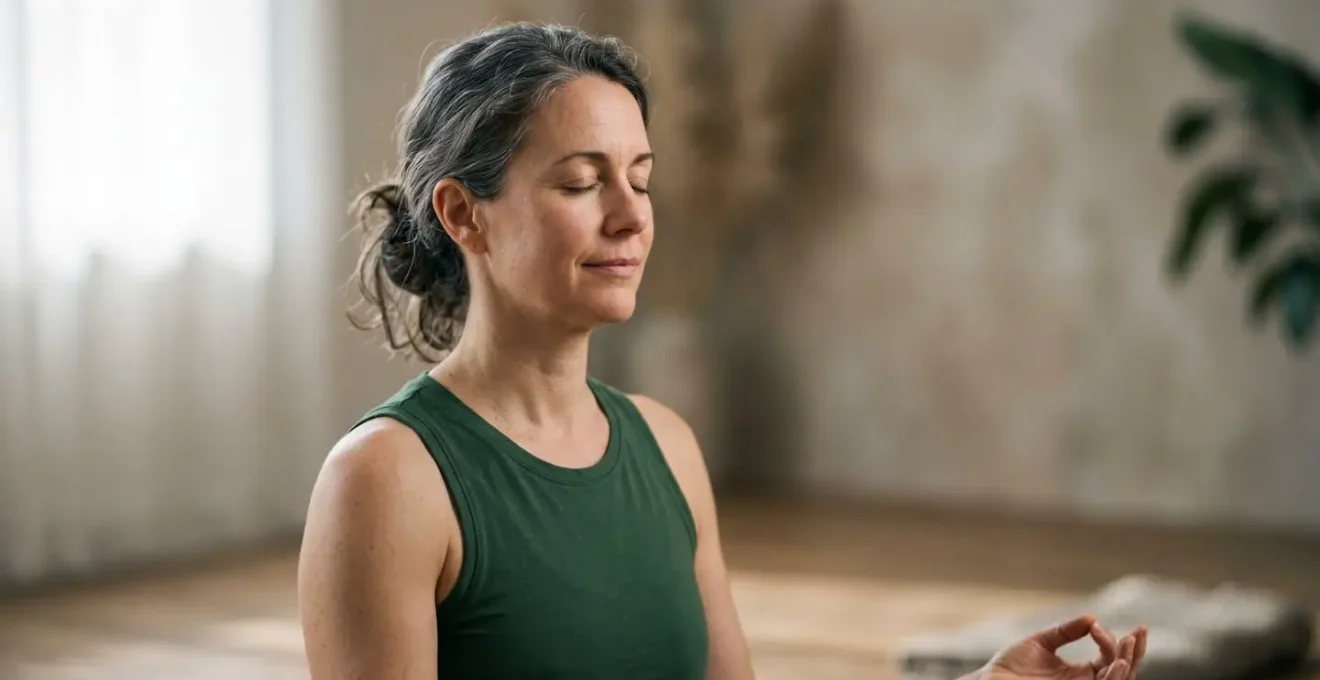
This inward focus is the antidote to comparison and unrealistic expectations. It honours where your body is today, which is the only place your practice can truly begin. Here are the top five beginner mistakes and how to reframe them:
- Comparing Yourself to Others: Instead of looking around the room, focus on your own alignment and breath. Remember that every person’s body has a different history and structure. Your pose will and should look different.
- Expecting Too Much, Too Soon: Many beginners feel discouraged when they can’t do a pose “perfectly” on day one. Accept where you are. The joy is in the process of discovery, not in achieving a final shape.
- Having the Wrong Teacher Match: A teacher’s style and personality matter immensely. If you feel intimidated or unseen, find another teacher. Look for someone compassionate who encourages you to listen to your body.
- An All-or-Nothing Mindset: Don’t quit because you miss a class or only have time for 10 minutes. A short, mindful practice is infinitely more beneficial than no practice at all. Consistency trumps duration.
- Being Intimidated by Sanskrit: Don’t let the Sanskrit names for poses (like Adho Mukha Svanasana for Downward-Facing Dog) put you off. You will pick them up naturally over time. A good teacher will always use the English name as well.
When Are You Ready to Move From Beginner to Intermediate Yoga Classes?
After a few months of consistent practice, many beginners start to wonder: “Am I ready for the next level?” It’s a valid question, but the answer has less to do with being able to perform complex poses and more to do with the quality of your awareness during practice. The transition from beginner to intermediate isn’t a race or a test; it’s a natural evolution that happens when the foundations have become second nature. While the majority of practitioners identify as beginners, moving to an intermediate level is about deepening your internal practice, not just your postures.
An intermediate practitioner no longer needs constant, explicit instruction for basic alignment. They understand how to engage their core, protect their joints, and, most importantly, they have developed a strong connection between breath and movement. In a Sun Salutation, for example, they are no longer just thinking about the next pose; the breath naturally guides the transition from one shape to the next. They have also learned the art of self-modification, intuitively knowing when to back off, when to go deeper, or when to use a prop like a block or a strap to support their body.
Ultimately, readiness is a feeling of confidence and self-reliance on the mat. It’s when your focus shifts from “Am I doing this right?” to “What am I feeling in this pose?” It signifies a move away from external validation towards internal awareness. To help you gauge where you are on this journey, here is a practical self-assessment checklist.
Your Readiness Self-Assessment Checklist
- Physical Competence: I can hold Downward-Facing Dog for at least 5 deep breaths without significant strain or pain.
- Breath Awareness: I automatically link my breath to movement (e.g., inhaling to lengthen, exhaling to deepen) without constant reminders.
- Self-Modification: I can intuitively choose to use a prop or take a less intense version of a pose based on how my body feels today.
- Focus Quality: My mind stays more on my breath and bodily sensations during class than on worrying about what others are doing or what’s for dinner.
- Ego Management: I can choose a simpler version of a pose, even if a more “advanced” one is offered, because it serves my body better in that moment.
If you can confidently say “yes” to most of these points after practicing 2-3 times per week for at least 3-6 months, you are likely ready to explore an intermediate class. Just remember to introduce it slowly, perhaps trying one intermediate class a week while continuing with your familiar beginner’s practice.
Why Being Flexible Does Not Mean You Can Move Well and What Mobility Actually Is?
In the world of yoga, the word “flexibility” is used constantly. We praise flexible people and aspire to become more flexible ourselves. But this focus on flexibility alone is misleading and can even be counterproductive. Flexibility simply refers to your passive range of motion—how far a joint can be moved with external help (like using your hands to pull your leg closer). Mobility, on the other hand, is your active range of motion. It is the ability to control your joints and limbs with strength and coordination throughout their entire range. You can be very flexible but have very poor mobility, which is a recipe for instability and injury.
Think of it this way: someone might be able to do the splits (passive flexibility), but can they lift their leg high in the air and hold it there using only muscle strength (active mobility)? The gap between what you can do passively and what you can do actively is your “mobility deficit.” A large gap means you have flexibility that you can’t control. In yoga, the goal is not to become as flexible as possible; it’s to shrink this mobility deficit. We want to build strength within our flexibility. This is what creates stable, resilient joints and graceful, controlled movement.
A true Hatha yoga practice is a brilliant tool for building this functional mobility. By holding poses, we aren’t just passively stretching. We are actively engaging muscles to support our skeletal structure, teaching the nervous system how to control our body in new positions. This is far more valuable than simply collapsing into a deep stretch. You can feel this difference in your own body with a simple test.
Your Passive vs. Active Mobility Self-Test
- Test Setup: Lie comfortably on your back on a mat.
- Passive Flexibility Test: Gently use your hands to pull your right knee in towards your chest. Notice how close it gets without pain. This is your passive range.
- Active Mobility Test: Now, release your hands completely. Using only the strength of your hip and core muscles, try to hold the knee in that same position.
- Measure the Gap: Observe the difference between where your hands could pull the knee and where your muscles can hold it. This gap is your mobility deficit.
- Interpretation: A large gap indicates you have flexibility without the strength to control it. The goal of your yoga practice is to build the strength to close that gap.
This simple test reveals a fundamental principle of safe practice. The aim isn’t just to increase the passive range but to develop the active strength to own and control that range. This is why a slow, mindful Hatha practice that focuses on engagement is often safer and more beneficial for long-term health than one that simply chases extreme flexibility.
Key Takeaways
- Authentic Hatha yoga is an internal practice of unifying breath, body, and mind, making it accessible to anyone, regardless of their starting flexibility.
- A safe and sustainable practice is built on awareness, consistency, and protecting your joints through mindful engagement, not on achieving aesthetic poses.
- The most profound benefits of yoga, such as improved mood, better immunity, and a calmer mind, are often invisible at first and develop over months of consistent practice.
How to Stay Motivated When Exercise Benefits Take Months to Become Visible?
One of the hardest parts of starting any new health routine is sticking with it during the initial phase when visible results, like weight loss or muscle definition, are slow to appear. Yoga is no different. The profound changes to your nervous system, mood, and overall well-being happen on a subtle level long before they manifest physically. This delay can be discouraging and is a primary reason people quit. A meta-analysis of 168 randomized controlled trials found that the overall dropout rate was 11.42% in yoga groups, and this increased for programs longer than 12 weeks. To build a lasting practice, we must learn to recognize and celebrate the “invisible” benefits from day one.
These benefits are the quiet shifts in your daily life. It might be the moment you notice you’re breathing more deeply while stuck in traffic, or that you feel less stiff getting out of a chair. It could be sleeping more soundly or reacting with a bit more patience to a frustrating email. These are the real fruits of the practice. They are signs that yoga is rewiring your nervous system for greater resilience and calm. The key to staying motivated is to train your attention to notice these micro-wins. As the image below evokes, the practice is about cultivating an inner state of peace and awareness, a benefit felt long before it is seen.
To make this process tangible, consider keeping a simple practice journal. This isn’t for tracking poses or duration, but for tracking sensations and small life improvements. By writing them down, you create a tangible record of your progress that goes far beyond what a mirror or scale can show you. This record becomes powerful fuel for your motivation on days when you don’t feel like getting on the mat.
Here’s a simple framework for a journal focused on invisible benefits:
- After Each Practice: Write one sentence about a non-physical sensation. Examples: “My mind felt quieter during the final rest,” or “I felt a sense of spaciousness in my chest today.”
- Weekly Check-in: Note any small, positive changes in your daily life. Examples: “I felt I was standing taller in the queue at the supermarket,” or “I handled a stressful meeting with more calm.”
- Monthly Reflection: Read your previous entries. This act of reviewing will reveal a pattern of progress that you would have otherwise forgotten, reinforcing the immense value of your consistent effort.
Why Exercise Does More for Your Brain, Immunity, and Mood Than Any Supplement?
In our modern search for quick fixes, it’s easy to reach for a pill or supplement promising to boost mood, sharpen focus, or strengthen immunity. While some supplements have their place, they often act as a passive intervention. True, lasting change in your well-being comes from active practices that teach your body and mind how to self-regulate. Hatha yoga, with its unique combination of physical postures (asana), breath regulation (pranayama), and mindfulness, is one of the most powerful tools available for this kind of active self-regulation.
The secret lies in yoga’s effect on the autonomic nervous system. This system has two main branches: the sympathetic (“fight-or-flight”) and the parasympathetic (“rest-and-digest”). Chronic stress keeps us stuck in a state of high sympathetic alert, which over time can weaken our immune system, disrupt our mood, and cloud our thinking. Yoga, and particularly the practice of pranayama, is a direct method for consciously activating the parasympathetic response. As expert Araceli De Leon explains, “Yoga helps regulate the parasympathetic nervous system by reducing resting heart rate, breathing patterns and allowing the body and mind to release stress from daily life.” This process actively strengthens your “vagal tone,” making your entire system more resilient to stress.
Yoga may help in increasing resiliency to life stressors and self-regulation, thus increasing vagal tone.
– Araceli De Leon, MS, American Council on Exercise
The impact of this self-regulation is profound. Scientific research confirms that simple breathing techniques taught in yoga have a measurable physiological effect. For example, slow breathing exercises at 6 breaths per minute have been shown to significantly increase parasympathetic activity. This is something no supplement can teach you to do for yourself. This active training of your nervous system is why yoga can have such a powerful effect on mental health challenges like depression and anxiety.
Case Study: Yoga’s Active Role in Improving Mental Health
In a study focusing on adults with depression, participants engaged in a hot yoga practice for 8 weeks. The results were significant: approximately 60% of participants experienced a reduction in their depression symptoms by at least 50%. This demonstrates the power of an active practice like yoga, which teaches practitioners the skill of self-regulating their own nervous system. Unlike a passive supplement that does something *to* you, yoga empowers you with the tools to change your own physiological and mental state from within, fostering a deep sense of self-efficacy.
Your journey into yoga is a personal one, a path of self-discovery rather than a race to a destination. The most important step is the first one. Start today by unrolling your mat for just ten minutes. Don’t worry about getting it “right.” Simply focus on the sensation of your breath moving in and out, and begin the gentle, compassionate conversation with your body. This is where the real practice begins.