
Contrary to popular belief, effective self-care isn’t about indulgent treats; it’s a diagnostic practice that precisely matches a restorative activity to a specific type of energy drain.
- Commercial self-care often fails because it ignores the deep-seated need for emotional, social, and spiritual restoration.
- True restoration comes from conducting a personal ‘energy audit’ to identify what depletes you and creating a ‘restoration menu’ to counteract it.
Recommendation: Stop asking “What self-care activity should I do?” and start asking “What kind of tired am I, and what is the specific antidote for that depletion?”
You’ve followed the advice. You’ve run the bubble bath, applied the expensive face mask, and lit the scented candle. You’ve carved out an hour for “me-time,” determined to recharge. Yet, when the water drains and the mask comes off, you’re left with the same profound sense of depletion. This experience is common for many UK adults who diligently engage in the commercialised rituals of self-care only to find themselves no more restored than when they started. The wellness industry sells us a catalogue of consumable treats, promising rejuvenation in a jar or a 20-minute session. But these often act as temporary distractions, not genuine restoration.
The problem isn’t that you’re “doing self-care wrong.” The problem is that the very definition we’ve been sold is fundamentally flawed. It treats all forms of exhaustion as equal, offering a one-size-fits-all solution for a highly personal problem. It often overlooks the most critical drains on our energy: emotional labour, social isolation, and a lack of purpose. Is it possible that the key to feeling truly restored lies not in adding more activities, but in developing a more intelligent, diagnostic approach? What if true self-care isn’t an act of indulgence, but an act of precision—a practice of matching a specific type of restoration to the specific type of energy you’ve lost?
This guide will deconstruct the myth of superficial self-care and provide a framework for building a personal practice that actually works. We will explore why ignoring our deeper needs is a recipe for burnout, how to conduct your own ‘energy audit’ to understand your unique depletion patterns, and how to create a ‘restoration menu’ that offers the right antidote at the right time. We will also tackle the practical barriers, from distinguishing care from avoidance to building the non-negotiable social connections that are more vital to our health than we imagine.
Contents: How to Go Beyond Superficial Self-Care
- Why Self-Care That Ignores Emotional, Social, and Spiritual Needs Always Fails?
- How to Design a Self-Care Menu That Matches What Actually Drains You?
- When Does Self-Care Become Avoidance and How to Tell the Difference?
- How to Practice Self-Care as a Parent, Carer, or Sandwich Generation Adult?
- How to Make Self-Care Appointments With Yourself That You Actually Keep?
- Why “Just Relax” Advice Makes Chronically Stressed People Feel Worse?
- How to Turn Acquaintances Into Close Friends Who Actually Support Your Health?
- Why Having Good Friends Might Be More Important for Your Health Than Exercise?
Why Self-Care That Ignores Emotional, Social, and Spiritual Needs Always Fails?
The modern concept of self-care often focuses on sensory pleasures—a hot bath, a piece of cake, a new skincare product. While these can provide fleeting comfort, they are fundamentally ill-equipped to address the deeper deficits that cause chronic depletion. This approach fails because it treats the symptoms (fatigue, stress) while ignoring the root causes, which are frequently embedded in our emotional, social, and spiritual lives. A face mask cannot resolve a lingering conflict with a colleague, and a bubble bath cannot cure the ache of loneliness. When our self-care rituals don’t acknowledge our need for connection, meaning, and emotional processing, they become mere distractions.
The stakes of ignoring these needs are alarmingly high, particularly when it comes to social connection. It’s not a “nice-to-have”; it’s a biological necessity. Research from the Stanford Center for Compassion and Altruism Research states that a “lack of social connectedness predicts vulnerability to disease and death beyond traditional risk factors such as smoking, blood pressure, and physical activity.” This isn’t hyperbole. The consequences are measurable and severe. In fact, a 2025 WHO report indicates that loneliness is linked to 871,000 deaths annually, which translates to a staggering 100 deaths every hour. These figures paint a stark picture: a self-care strategy that doesn’t actively nurture social bonds is, at its core, a failing health strategy.
Ignoring our spiritual needs—our sense of purpose, values, and connection to something larger than ourselves—creates a similar void. Without a “why” to guide us, our daily actions can feel hollow, leading to a state of existential exhaustion that no amount of physical rest can fix. True, sustainable self-care must therefore be a holistic practice. It must be an integrated system that diagnoses and addresses depletion across all dimensions of our being, treating our social and emotional health with the same urgency we afford our physical bodies.
How to Design a Self-Care Menu That Matches What Actually Drains You?
The most powerful shift in creating an effective self-care practice is moving from a generic checklist to a personalised prescription. This begins with a simple but profound diagnostic tool: the Energy Audit. Instead of just guessing what might make you feel better, you must first become a detective of your own depletion. The goal is to identify not just *that* you are tired, but *what kind* of tired you are. Is it the mental fog after a day of intense focus? The emotional rawness after a difficult conversation? The physical weariness from a long commute? Or the social exhaustion from being “on” all day?
Each type of drain requires a specific type of restoration. Applying the wrong antidote can be ineffective or even counterproductive. For example, if you’re suffering from sensory overload after a day in a noisy open-plan office, scrolling through a stimulating social media feed is not self-care; it’s pouring more fuel on the fire. What you truly need is sensory rest—silence, a walk in nature, or listening to calming music. The key is to create a ‘Restoration Menu,’ a personalised list of activities that directly counteract your most common drains. This menu becomes your go-to toolkit for genuine recovery.
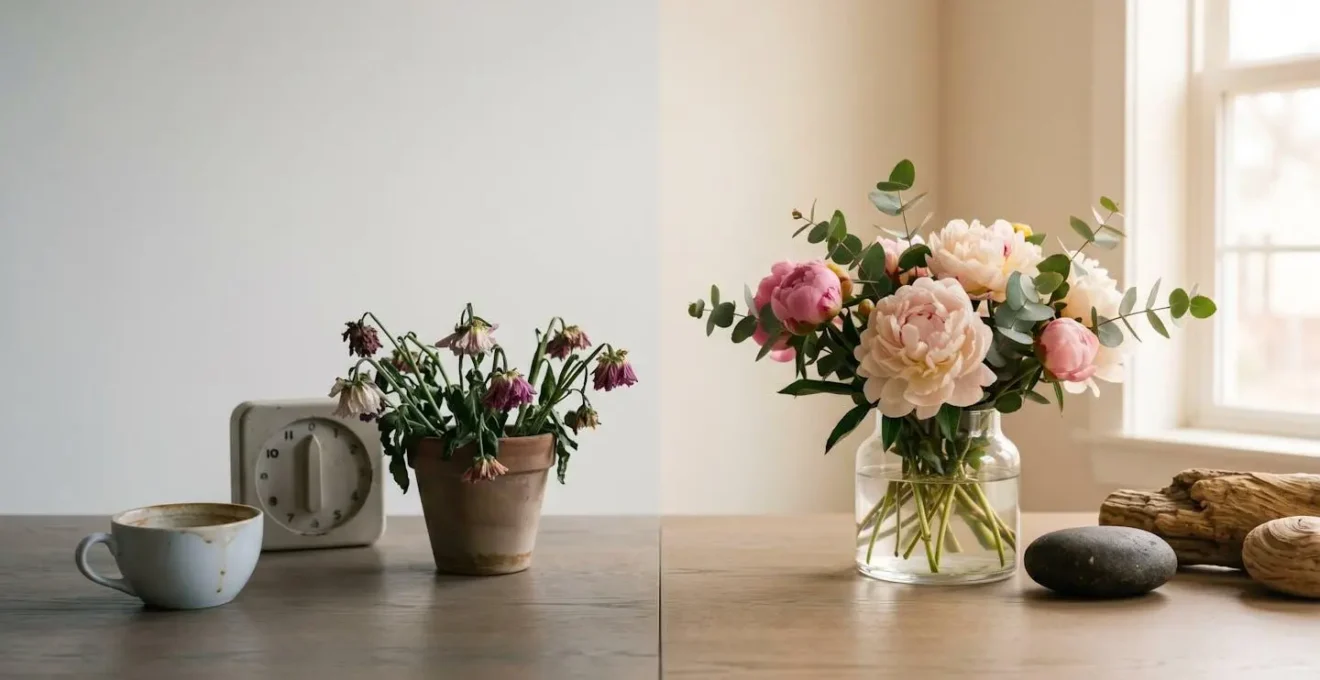
This visual concept of balancing drains with rechargers is the heart of a sustainable practice. It requires you to be an active participant in your own wellbeing, not a passive consumer of wellness products. By systematically identifying what depletes you and what restores you, you transform self-care from a hopeful guess into a reliable skill. It’s about building a system that honours your unique needs and provides the right support at the right moment.
Your Action Plan: The Energy Audit Framework
- Track Your Energy: For one typical week, track your activities in a journal. Note your energy level (on a scale of 1-10) before and after each major task, meeting, or social interaction.
- Colour-Code Your Activities: Review your week and colour-code each entry. Use Red for ‘Drains’ (activities that left you depleted), Green for ‘Rechargers’ (activities that restored your energy), and Yellow for ‘Neutrals’.
- Identify the Drain Type: For each Red activity, identify the primary type of drain: Cognitive (intense focus, problem-solving), Emotional (managing feelings, difficult conversations), Physical (bodily exhaustion), or Social (people overload, performing).
- Match Drains with Restoration: Design your ‘Restoration Menu’ by matching each drain type with its opposite form of rest. For example, a cognitive drain may need sensory restoration (listening to music, a walk in nature), while an emotional drain may need social restoration (a safe conversation with a trusted friend).
- Build Your Menu: Create your personal ‘Restoration Menu’ with at least 2-3 practical, accessible options for each drain type you commonly experience. This is your personalised prescription for exhaustion.
When Does Self-Care Become Avoidance and How to Tell the Difference?
A critical danger in the pursuit of self-care is the fine line between restoration and avoidance. Many activities that we label as “self-care”—binge-watching a series, scrolling social media for hours, or having that extra glass of wine—can easily become sophisticated forms of procrastination. They offer a temporary numbing of discomfort or a distraction from a task or feeling we don’t want to face. While they might provide short-term relief, these avoidance behaviours ultimately increase our stress and deplete our capacity to handle challenges in the long run. The difficult task remains, now with an added layer of guilt or anxiety for having put it off.
So, how can we tell the difference? The key lies in the post-activity outcome. True self-care, even if it’s uncomfortable at first (like setting a difficult boundary or having a vulnerable conversation), leaves you feeling more resourced, capable, and resilient afterward. It builds your capacity to engage with your life. Avoidance, on the other hand, provides a fleeting escape but ultimately leaves you feeling more depleted, anxious, or stuck. It subtracts from your long-term capacity.
The Post-Activity Feeling Diagnostic: Distinguishing Restoration from Escape
Holistic mental health research offers a clear way to distinguish true self-care from avoidance behaviours by examining how you feel *after* the activity. Restorative practices like establishing boundaries, engaging in a digital detox, or mindful movement might feel challenging during the act itself, but they consistently leave individuals feeling more resourced and better equipped to face life’s stressors. In contrast, as highlighted by approaches from institutions like Ascent Mental Health, avoidance behaviours such as using excessive screen time to escape rather than to rest, provide temporary relief but are typically followed by increased anxiety about postponed responsibilities and a reduced overall capacity to handle future stressors. The litmus test is simple: Does this activity build my future capacity, or does it borrow energy from tomorrow?
To make this distinction in the moment, ask yourself a simple question: “Am I doing this to recharge so I can face my life, or am I doing this to escape from my life?” The answer will reveal the true nature of the activity. Choosing a 30-minute walk in the park to clear your head before tackling a difficult email is restoration. Watching three hours of television to forget that the email exists is avoidance. Learning to be honest with yourself about your intentions is a foundational skill for building a self-care practice that genuinely supports you.
How to Practice Self-Care as a Parent, Carer, or Sandwich Generation Adult?
For those in caring roles—parents, family carers, or adults sandwiched between the needs of ageing parents and young children—the advice to “just take more time for yourself” can feel like a cruel joke. When your time is not your own and you are responsible for the wellbeing of others, traditional, time-intensive self-care rituals are often impossible. The feeling of being “on-call” 24/7 is a significant source of chronic stress. In the U.S., for instance, data shows that 64% of caregivers report high emotional stress, and 45% report high physical strain. This reality demands a radical redefinition of self-care, away from grand gestures and towards sustainable micro-practices.
The key for carers is to focus on ‘small-dose’ restoration that can be integrated into the gaps of the day. This isn’t about finding an hour; it’s about reclaiming five minutes. It’s about letting go of the all-or-nothing mindset that says, “If I can’t go to a yoga class, there’s no point.” Instead, the focus shifts to small, high-impact actions that can be done anywhere. This could be three minutes of deep, diaphragmatic breathing while waiting for the kettle to boil. It might be stepping outside for 60 seconds to look at the sky and feel the air on your face between tasks. It could even be putting on headphones and listening to one favourite song without interruption.
These micro-practices work because they help regulate the nervous system, pulling it out of the constant ‘fight or flight’ state that caregiving can induce. They are not about solving all problems, but about creating tiny pockets of recovery that make the overall load more manageable. For a carer, self-care is not selfish; it is a fundamental prerequisite for sustainability. You cannot pour from an empty cup. These small, intentional acts of restoration are the essential work of refilling that cup, one drop at a time, ensuring you have the capacity to continue caring for those who depend on you.
How to Make Self-Care Appointments With Yourself That You Actually Keep?
One of the biggest hurdles to consistent self-care is our tendency to treat it as optional. We schedule work meetings, dental appointments, and parent-teacher conferences as non-negotiable blocks in our calendars. Yet, the time we set aside for our own restoration is often the first thing to be sacrificed when a more “important” demand arises. To change this, you must start treating self-care with the same gravity as any other professional or personal commitment. It needs to become a formal appointment with the most important person in your life: yourself.
The first step is to literally schedule it. Open your calendar and block out time for your restorative practices, whether it’s a 15-minute walk, 20 minutes of reading, or a weekly call with a friend. Use a specific title, not just “break.” Name the activity: “Solo walk – no phone” or “Reading time – fiction.” This small change in language reinforces its purpose and legitimacy. Defend this time as fiercely as you would a meeting with your boss. If someone asks for that time, your default response should be, “I’m sorry, I have an appointment then.” You don’t need to justify what it is.

To increase your chances of keeping these appointments, reduce the friction. If your goal is a morning walk, lay out your clothes the night before. If you want to journal, leave the notebook and pen open on your desk. Furthermore, attach your self-care habit to an existing one—a practice known as ‘habit stacking.’ For example, “After I finish my morning coffee, I will meditate for five minutes.” Finally, start small. A five-minute appointment that you actually keep is infinitely more powerful than a one-hour appointment that you constantly cancel. By proving to yourself that you can honour these small commitments, you build the integrity and self-trust needed to maintain a lasting, restorative practice.
Why “Just Relax” Advice Makes Chronically Stressed People Feel Worse?
For someone in a state of chronic stress, the seemingly helpful advice to “just relax” can be profoundly invalidating and counterproductive. It implies that relaxation is a simple choice and that their inability to do so is a personal failing. The reality is that long-term stress is not just a state of mind; it physically changes the brain’s structure and function, making it biochemically difficult to switch off. The brain’s threat-detection centre, the amygdala, becomes overactive, while the prefrontal cortex, responsible for rational thought and emotional regulation, becomes less effective. You are, in essence, hard-wired for high alert.
Telling a chronically stressed person to relax is like telling someone with a broken leg to “just walk it off.” Their system has lost its natural ability to down-regulate. In fact, the command to relax can introduce a new layer of stress: performance anxiety about failing to relax. This creates a vicious cycle where the pressure to calm down only amplifies the internal state of agitation. This isn’t a psychological weakness; it’s a physiological reality. Extensive neuroscience research demonstrates that chronic stress causes atrophy of neurons in the hippocampus and prefrontal cortex while causing hypertrophy of neurons in the amygdala. Your brain’s architecture has been remodelled by stress, favouring anxiety and threat detection over calm and reason.
The antidote is not a vague command but a concrete, body-based action. Instead of trying to *think* your way into relaxation, you must *act* your way into it. This involves activities that actively signal safety to the nervous system. Practices like slow, deep breathing, gentle stretching, walking, or even applying a weighted blanket work by engaging the parasympathetic nervous system—the body’s “rest and digest” mode. These are not about forcing relaxation, but about creating the physiological conditions where relaxation can naturally occur. It’s a process of gently guiding the body back to a state of equilibrium, not demanding it.
How to Turn Acquaintances Into Close Friends Who Actually Support Your Health?
In a world of digital connections, it’s easy to accumulate hundreds of “friends” or acquaintances while still feeling profoundly isolated. The gap between an acquaintance and a true, supportive friend is vast, but the bridge between them is built with two materials: consistency and vulnerability. Transforming a casual connection into a meaningful friendship is an active, intentional process, not something that happens by chance. It requires moving beyond conversations about weather and work and into the realm of shared personal experience.
Consistency is the foundation. Friendship needs regular contact to grow. This doesn’t have to be a grand gesture; it can be a simple, consistent rhythm of reaching out. A weekly text to check in, a recurring monthly coffee, or sharing an article you know they’d appreciate are all small deposits into the bank of friendship. The goal is to move the relationship from an occasional event to a regular presence in each other’s lives. This regular contact creates the safety and familiarity necessary for the next, more crucial step: vulnerability.
Vulnerability is the catalyst that deepens a connection. It’s the act of sharing something authentic about your struggles, your hopes, or your fears. This doesn’t mean oversharing or trauma-dumping. It means testing the waters by sharing a small, genuine piece of yourself. For example, instead of saying “work was busy,” you might try, “I’m feeling a bit overwhelmed with a project at work.” This offers an invitation for the other person to reciprocate. When they respond with empathy and perhaps share a vulnerability of their own, trust is built. It is in this reciprocal exchange of authentic sharing that acquaintanceship blossoms into a friendship that can genuinely support your health and wellbeing.
Key Takeaways
- True self-care is a diagnostic process, not a generic prescription. It requires matching a specific restorative activity to a specific type of energy drain.
- Ignoring social and emotional needs in favour of purely physical or sensory treats is the primary reason most self-care routines fail to deliver lasting restoration.
- Social connection is not a luxury but a biological necessity for health, with a measurable impact on longevity and mortality risk that can exceed that of traditional health factors.
Why Having Good Friends Might Be More Important for Your Health Than Exercise?
In our health-conscious culture, we meticulously track our steps, monitor our diets, and schedule our gym sessions. Yet, we often neglect one of the most powerful determinants of our long-term health and longevity: the quality of our social connections. While it may sound like a radical claim, a growing body of robust scientific evidence suggests that nurturing strong friendships may have a greater impact on our lifespan than traditional physical health behaviours like exercise. This is not to diminish the importance of physical activity, but to elevate social health to its rightful place as a non-negotiable pillar of wellbeing.
The data on the mortality risks of isolation is staggering. A landmark 2023 meta-analysis of 90 cohort studies found that social isolation increases all-cause mortality risk by 32%. This effect is comparable to, or even exceeds, the risks associated with well-known factors like obesity or physical inactivity. The inverse is also true: strong social ties promote a longer, healthier life. Research from Stanford University’s CCARE program shows that strong social connection leads to a 50% increased chance of longevity. Friends are not just for fun; they are a critical part of our immune system’s support crew and our primary buffer against life’s inevitable stressors.
Why is friendship so potent? Close friends provide essential emotional and practical support, which helps to regulate our stress response and lower chronic inflammation—a key driver of age-related diseases. They provide a sense of belonging and purpose, which are crucial for mental health. They also influence our behaviours, encouraging healthier habits and providing accountability. In a very real sense, your friends are a form of preventative medicine. Prioritising time to build and maintain these deep connections is not an indulgence; it is one of the most significant investments you can make in your long-term health.
Building a life that feels truly restorative is not about adding more to your to-do list. It’s about a fundamental shift in perspective: from passive consumption to active diagnosis, from generic rituals to personalised restoration, and from solitary pursuits to deep, life-sustaining connection. Start today by conducting your own energy audit and taking one small step to invest in a friendship that matters.