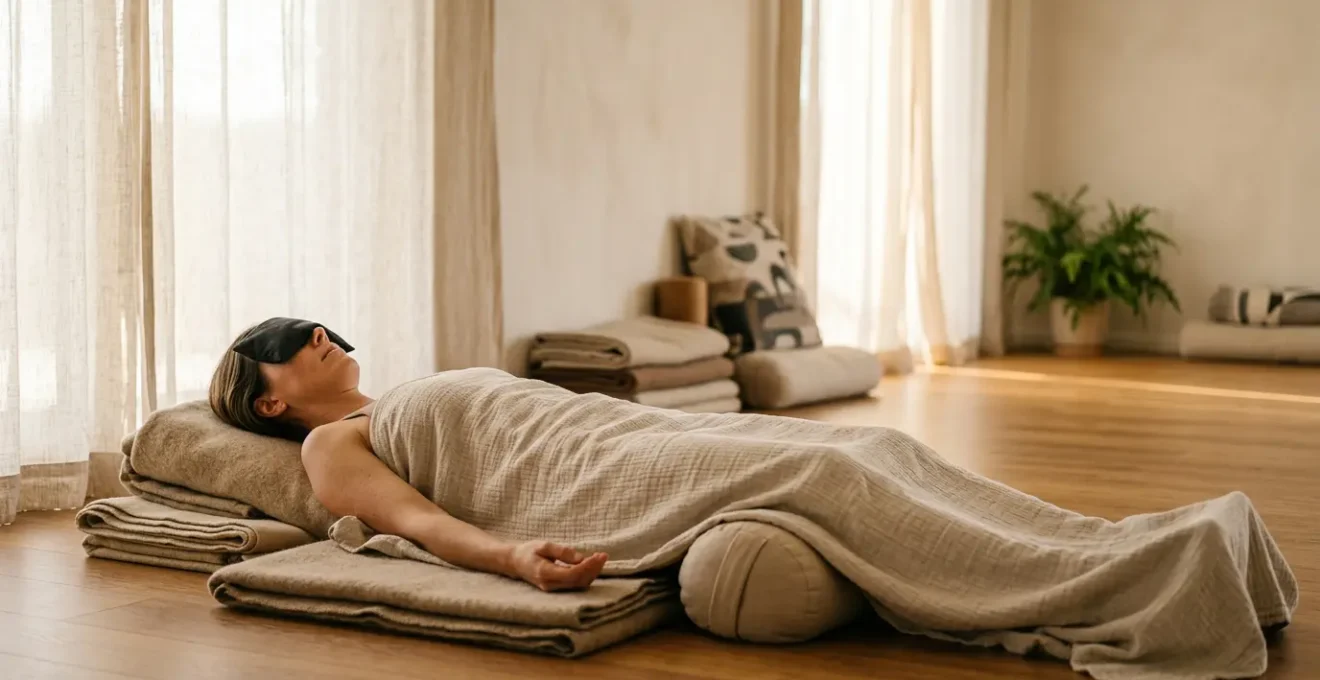
Contrary to popular belief, a stressed nervous system doesn’t need to be “sweat out”; it needs to feel safe enough to stand down.
- Vigorous yoga can keep a burnt-out body in a “fight-or-flight” state, deepening exhaustion.
- Restorative yoga uses props to create supported stillness, signalling safety to the brain and activating the “rest-and-digest” nervous system response.
Recommendation: Instead of pushing through another power flow, create the conditions for rest by trying one fully supported pose for 10 minutes using pillows you already own.
You’ve been diligent. You attend your vinyasa or power yoga classes, pushing through challenging flows and holding strong poses, all in the name of stress relief. Yet, you leave the mat feeling wired, agitated, or just as wound up as when you started. You might even lie in Savasana at the end, your mind racing, wondering why you can’t “just relax” like everyone else. This experience is common, and it’s not a personal failing. It’s a physiological misunderstanding of what a chronically stressed body truly needs.
The fitness world often tells us to fight stress with intensity, to burn it off through strenuous effort. But when your nervous system is already in a state of high alert—what scientists call sympathetic activation—more intensity is like pouring fuel on a fire. The very practices you’re using to find calm may be reinforcing the cycle of hypervigilance and exhaustion. But what if the most powerful and transformative practice wasn’t about doing more, but about strategically and profoundly doing less?
This is the principle behind restorative yoga. It’s not about stretching or strengthening; it’s a practice of supported stillness designed to give your nervous system the signals of safety it needs to shift into a healing state. This article will guide you through the science of why this gentle approach is so potent for deep recovery. We will explore how to create this practice at home, differentiate it from similar styles, and understand how to integrate it into your life to finally move from being wound up to truly unwound.
To help you navigate this paradigm shift from effort to ease, we’ve structured this guide to answer your most pressing questions. Here is what we will cover.
Summary: Why Active Yoga Classes Might Be Adding to Your Stress Rather Than Relieving It?
- Why Lying Still With Props Does More for Your Nervous System Than Power Yoga?
- How to Create a Restorative Yoga Setup Using Pillows and Blankets You Already Own?
- Restorative Yoga, Yin, or Yoga Nidra: Which Practice Suits Your Exhaustion Level?
- Why Lying Still Feels Unbearable When You Most Need Rest and How to Ease In?
- When to Schedule Restorative Yoga: After Hard Workouts, Before Sleep, or on Rest Days?
- Why “Just Relax” Advice Makes Chronically Stressed People Feel Worse?
- Why Sleep Hygiene Tips Do Not Work When You Have Already Tried Everything?
- How to Create a 30-Minute Wind-Down Routine That Signals Sleep to Your Brain?
Why Lying Still With Props Does More for Your Nervous System Than Power Yoga?
To understand why supported stillness can be more beneficial than a dynamic flow, we need to look at our nervous system. It has two main branches: the sympathetic (‘fight-or-flight’) and the parasympathetic (‘rest-and-digest’). A vigorous power yoga class, with its focus on muscular effort and holding strong poses, primarily activates the sympathetic nervous system. For someone who is already chronically stressed, this can simply reinforce the body’s state of high alert.
Restorative yoga does the opposite. By supporting the body completely with props like bolsters and blankets, we eliminate the need for muscular effort. This sends a powerful signal of safety to the brain. When the body feels safe and held, it can finally switch off the alarm bells and activate the parasympathetic nervous system. This is where true recovery happens: heart rate slows, blood pressure drops, and digestion improves. It’s a physiological invitation to heal.
The neurochemical effects are profound. This state of deep rest allows the brain to produce more Gamma-aminobutyric acid (GABA), a neurotransmitter that has a calming effect. In fact, one study demonstrated that even a single yoga session can result in a 27% increase in brain GABA levels. Rather than forcing relaxation through exhaustion, restorative yoga creates the ideal neurobiological conditions for the mind and body to enter a state of ease naturally.

As you can see in this image, every part of the hand is at ease. There is no tension, no holding, no effort. This is the physical expression of a parasympathetic state. It’s not something you achieve through willpower; it’s something you allow to happen when the right conditions of support and safety are met. This is the fundamental gift of restorative practice.
How to Create a Restorative Yoga Setup Using Pillows and Blankets You Already Own?
One of the biggest misconceptions about restorative yoga is that you need a studio full of expensive, specialised equipment. This simply isn’t true. The purpose of the props is to create support and signal safety, and you can achieve this with items you likely already have in your home. The key is creativity and understanding the function of each prop.
A firm bolster, for example, is the cornerstone of many poses. You can easily replicate this by taking two or three firm blankets, stacking them, and rolling them very tightly into a dense cylinder. Securing the roll with a belt or a couple of scarves can help it keep its shape. Similarly, firm couch cushions or even a rolled-up duvet can serve the same purpose. Yoga blocks provide height and stable support, but a stack of thick books (like hardcover textbooks) works just as well.
The story of one restorative yoga teacher perfectly illustrates this principle of resourcefulness. Her most profound early practices were done at home using a duvet, tightly rolled and tied with two old neckties, as a substitute for a bolster. By teaching her students to see the potential in their own household items, she made the practice radically accessible. This approach not only removes the financial barrier to entry but also honours the yogic principle of aparigraha (non-possessiveness), reminding us that deep rest is an internal state, not a product you can buy.
Here are some fundamental ways to use household items for a restorative setup:
- For an inclined back support: Stack two bed pillows on top of each other, with the top one slightly further back to create a gentle slope for your spine and head.
- For knee support: In any reclined pose, place a rolled-up blanket or a couch cushion under your knees. This releases tension in the lower back and psoas muscle, a primary “fight-or-flight” muscle.
- For neck support: A small, folded hand towel or a soft blanket can be placed under your neck to maintain its natural curve and prevent strain.
- To create a “somatic container”: Use folded blankets or pillows on either side of your body or head. This gentle pressure can create a feeling of being held and swaddled, blocking out external stimuli and deepening your sense of security.
Restorative Yoga, Yin, or Yoga Nidra: Which Practice Suits Your Exhaustion Level?
The landscape of quiet yoga can be confusing. When you’re feeling depleted, should you choose Restorative, Yin, or Yoga Nidra? While all three are slow and calming, they have distinct aims and target different systems in the body. Choosing the right one for your specific type of exhaustion is crucial for effective recovery. Restorative yoga’s primary goal is to down-regulate the nervous system, while Yin yoga targets connective tissues and Yoga Nidra works with states of consciousness.
Restorative yoga restores the body. You set students up in supported poses and hold those shapes for five to twenty minutes each. Yoga nidra restores awareness. Your students lie in one position and you guide their attention through a series of internal layers.
– Sage Rountree, Yoga Nidra vs. Restorative Yoga: What’s the Difference?
This comparative table, based on an analysis of these distinct practices, breaks down the key differences to help you decide which practice is best for you right now.
| Practice Type | Primary Target | Pose Duration | Prop Usage | Best For |
|---|---|---|---|---|
| Restorative Yoga | Nervous system reset – activates parasympathetic ‘rest and digest’ | 5-20 minutes per pose | Heavy support (bolsters, blankets, blocks create complete comfort) | Complete burnout, sympathetic overload, chronic stress |
| Yin Yoga | Connective tissue (fascia, ligaments) – increases joint mobility | 3-5 minutes per pose | Minimal props (mild support to deepen stretch) | Physical tension, tightness, desire for flexibility with mental calm |
| Yoga Nidra | Brainwave patterns – guides consciousness between waking and sleep | 20-45 minutes in single position (Savasana) | Simple setup (one blanket, one pillow) | Insomnia, racing mind, mental overload, memory/creativity enhancement |
In short, if you feel utterly burnt out, overstimulated, and your body is crying out for a hard reset, Restorative Yoga is your sanctuary. If you feel physically tight, stiff, and are seeking to release deep-seated tension in your joints while staying mentally present, Yin Yoga is the answer. And if your mind is what feels most exhausted—if you’re battling insomnia or a racing brain—Yoga Nidra offers a direct path to deep mental rest by guiding your consciousness into the space between waking and sleeping.
Why Lying Still Feels Unbearable When You Most Need Rest and How to Ease In?
You’ve set up your props, you’re lying in a supported pose, and you’ve been told to relax. But instead of calm, you feel a surge of anxiety, a desperate urge to fidget, or a flood of racing thoughts. This experience can be deeply disheartening, making you feel like you’re “failing” at relaxation. The truth is, this is a very common and logical response from a nervous system conditioned to be on high alert. For a body stuck in a hypervigilant state, stillness can feel profoundly unsafe. The absence of external threats or tasks can cause the brain to turn inward and amplify internal anxieties.
Your inability to immediately settle is not a flaw; it’s a sign of how deeply your system is entrenched in a sympathetic (fight-or-flight) state. It’s a protective mechanism that has been working overtime. In fact, research shows that many with chronic stress may not achieve a parasympathetic state even during sleep, which explains why you can get eight hours and still wake up exhausted. Forcing stillness onto this agitated state is counterproductive. The key is to create conditions of safety so gently that the body can choose to let go on its own terms.
So, how do you ease in? The goal is not to eliminate the agitation but to gently widen your “Window of Tolerance” for stillness. Start small:
- Reduce the time: Instead of a 20-minute pose, give yourself permission to stay for just 3-5 minutes. Consistency is more important than duration.
- Add gentle weight: Place a folded blanket over your hips or abdomen. The gentle pressure can be incredibly grounding and soothing, like a reassuring hand.
- Occupy the mind gently: Instead of striving for an empty mind, give it a simple, soothing task. Count your breaths, notice the sensation of the air at your nostrils, or listen to the ambient sounds in the room without judgment.
- Cover your eyes: Using an eye pillow or a soft cloth over your eyes can significantly reduce sensory input and signal to your brain that it’s safe to power down.

The journey from resistance to release is a delicate one. It requires immense self-compassion. Give yourself permission for it to feel messy at first. Your only job is to create the supportive conditions; your body knows how to do the rest when it finally feels safe enough to do so.
When to Schedule Restorative Yoga: After Hard Workouts, Before Sleep, or on Rest Days?
Integrating restorative yoga into your life isn’t just about what you do, but when you do it. Strategic timing can amplify the benefits, helping you align the practice with your body’s natural rhythms and needs. Rather than seeing it as another item on your to-do list, think of it as a tool you can deploy at specific moments for maximum effect. The goal is to support your nervous system’s transition from an active, sympathetic state to a restful, parasympathetic one.
The science supports this targeted approach. For example, using a restorative pose after intense exercise helps to downshift the nervous system and clear stress hormones like cortisol that are produced during the workout. Similarly, a pre-sleep practice can be a powerful biological trigger for sleep onset. It’s not just about feeling relaxed; it’s about actively facilitating the physiological shifts required for deep rest. In fact, studies show that parasympathetic nerve activity is significantly enhanced for about 60 minutes after a yoga session, making that post-practice window a prime time for recovery or sleep preparation.
Here are some strategic ways to schedule your practice:
- Post-Workout Reset (10-15 minutes): Immediately after a run, HIIT session, or power yoga class, transition into a single supported pose like Legs-Up-the-Wall (Viparita Karani). This helps shift you out of the ‘fight-or-flight’ state required for exercise and into the ‘rest-and-digest’ state needed for muscle repair and recovery.
- Pre-Sleep Wind-Down (20-30 minutes): Practicing about 90 minutes before your intended bedtime can be ideal. It allows your nervous system to settle and your core body temperature to drop, which is a key biological signal for sleep.
- Rest Day Deep Dive (45-60 minutes): Use your designated rest days for a longer, multi-pose sequence. This acts as deep maintenance for your nervous system, helping to process accumulated stress and build long-term resilience against burnout.
- Mid-Workday “Pattern Interrupt” (5-10 minutes): If you feel stress building during the day, take a short break for a supported Child’s Pose or a simple seated forward bend over a pillow. This micro-dose of rest can prevent stress from escalating into a full-blown sympathetic overload by evening.
The key is to listen to your body. On days you feel energetic, your morning vinyasa flow is perfect. On days you feel frayed and exhausted, swapping that active practice for a 30-minute restorative session in the evening is the most intelligent and compassionate choice for your long-term well-being.
Why “Just Relax” Advice Makes Chronically Stressed People Feel Worse?
For anyone living in a state of chronic stress, the words “just relax” can feel like a profound invalidation of their experience. This seemingly helpful advice often backfires, creating a secondary layer of stress: the pressure to succeed at relaxing. When your body is flooded with stress hormones like adrenaline and cortisol, it is physiologically primed for action—to fight, flee, or freeze. Your muscles are tense, your heart rate is elevated, and your mind is on high alert for danger. In this state, relaxation isn’t a switch you can simply flip.
This phenomenon is known as the paradox of effort in relaxation. Yoga instructors often observe it in students who are agitated or fidgety during Savasana (corpse pose) at the end of a challenging class. These students perceive relaxation not as a state of being, but as another performance task. When they inevitably “fail” to achieve a calm, empty mind on command, they feel frustrated and even more stressed than before. They are, in essence, trying to fight their way to peace, which is a physiological impossibility.
The Paradox of Effort: A Teacher’s Observation
An experienced teacher noticed that the most agitated students were often the ones who tried the hardest to be still. For them, Savasana wasn’t rest; it was a test. The solution wasn’t to command them to relax more forcefully. Instead, the teacher began offering extensive props—bolsters under the knees, blankets for weight, eye pillows—and reframed the goal. The objective, she explained, was not to *achieve* relaxation but to simply *create the conditions* for it. The practice became about dropping the fight against anxiety, not eliminating it. Over time, this permission-based approach helped students gently widen their capacity for stillness, proving that safety, not force, is the true antidote to a hypervigilant nervous system.
Telling a stressed person to “just relax” is like telling someone in a storm to “just be dry.” It ignores the reality of their environment. The restorative approach, by contrast, doesn’t command you to be dry; it offers you a warm, supportive shelter. It acknowledges the storm you’re in and provides a safe harbour, allowing your system to stand down naturally when it senses the danger has passed.
Key Takeaways
- An over-stressed nervous system responds better to supported safety than to more intense effort.
- You can create effective restorative setups using common household items like pillows and blankets.
- Stillness can feel agitating at first; this is a normal physiological response, not a personal failure.
Why Sleep Hygiene Tips Do Not Work When You Have Already Tried Everything?
You’ve done it all. You’ve got blackout curtains, you avoid blue light from screens before bed, you’ve cut out caffeine, and your bedroom is a cool, dark sanctuary. Yet you still lie awake for hours, your mind racing, or you wake up feeling unrefreshed. This frustrating experience, sometimes called “orthosomnia” (the anxious pursuit of perfect sleep), is common when standard sleep hygiene advice fails to address the root cause of sleeplessness: a dysregulated nervous system.
Sleep is not a behaviour you can control; it’s a biological state you must allow to happen. When your body is stuck in a sympathetic ‘fight-or-flight’ state, it is physiologically on high alert. No amount of dark rooms or herbal tea will override a system that believes it is in imminent danger. As one expert aptly puts it, if the body is stuck in a ‘sympathetic’ state, no amount of dark rooms or screen avoidance will fix the root cause, which is an internal state of high alert. The problem isn’t your environment; it’s your internal alarm system being stuck in the ‘on’ position.

This is where restorative practices become a crucial, and often missing, piece of the puzzle. Instead of focusing on the external “rules” of sleep hygiene, restorative yoga works on the internal environment of your nervous system. As studies indicate that regular practice can improve sleep quality, it does so by teaching your body, on a deep physiological level, how to shift from the sympathetic to the parasympathetic state. It’s a way of actively training your nervous system to stand down, making it possible for sleep to arise naturally once you get into bed.
So, if you’ve tried everything and sleep still eludes you, it might be time to stop optimising your bedroom and start tending to your nervous system. The goal is to get into bed already feeling safe and settled, rather than hoping the bed itself will magically make you feel that way.
How to Create a 30-Minute Wind-Down Routine That Signals Sleep to Your Brain?
To truly prepare for sleep, you need to send clear, consistent signals to your brain that the day is over and it is safe to power down. A multi-sensory wind-down routine, performed in the same sequence each night, can create a powerful conditioned response that makes falling asleep more automatic. This isn’t about following rigid rules; it’s about creating a personal ritual that communicates safety to your nervous system on every level.
Think of it as guiding your body and mind through a series of “gates” that lead toward sleep. The first gate is visual, shifting the light to signal sunset. The next is thermal, using a change in body temperature as a biological trigger. The final gates are kinesthetic and auditory, releasing physical tension and quieting the external world. By moving through this sequence, you are working with your body’s innate biology rather than against it.
This approach moves beyond simple “sleep hygiene” to a more holistic, nervous-system-aware preparation for rest. It’s a proactive way to create the internal conditions necessary for sleep to happen effortlessly. Over time, your brain will learn to associate this sequence with sleep, initiating the process automatically as soon as you begin your ritual.
Your 30-Minute Wind-Down Ritual Checklist
- The Visual Signal (Minutes 0-5): Dim all overhead lights. Switch to warm-toned lamps (ideally 2700K) or even candlelight. Your brain interprets warm, dim light as sunset, which is a primary trigger for melatonin production to begin.
- The Thermal Signal (Minutes 5-15): Take a warm (not hot) shower or bath. The subsequent, gradual drop in your core body temperature after you get out is one of the most powerful biological triggers for sleep onset.
- The Kinesthetic Signal (Minutes 15-27): Move through just two or three simple, supported restorative poses. Favourites include Supported Child’s Pose (over a pillow), Legs-Up-the-Wall, or Reclined Bound Angle Pose with bolsters under the knees. This helps to release physical holding patterns and activate the parasympathetic nervous system.
- The Auditory Signal (Minutes 27-30): As you get into bed, transition from any music or podcasts to complete silence or a source of white/pink noise. This signals to the brain that external stimulation is ending and it’s time for internal processing (i.e., sleep) to begin.
- Consistency Over Perfection: The real magic is in the repetition. Performing this exact sequence at the same time each evening for 2-3 weeks will create a Pavlovian-like response, making sleep a more automatic and less anxious process.
Begin tonight by choosing just one or two of these signals to implement. By consistently offering your body these cues of safety and rest, you are not just preparing for one night of better sleep; you are rebuilding a foundation of nervous system resilience that will serve you for years to come.